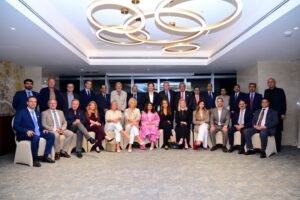
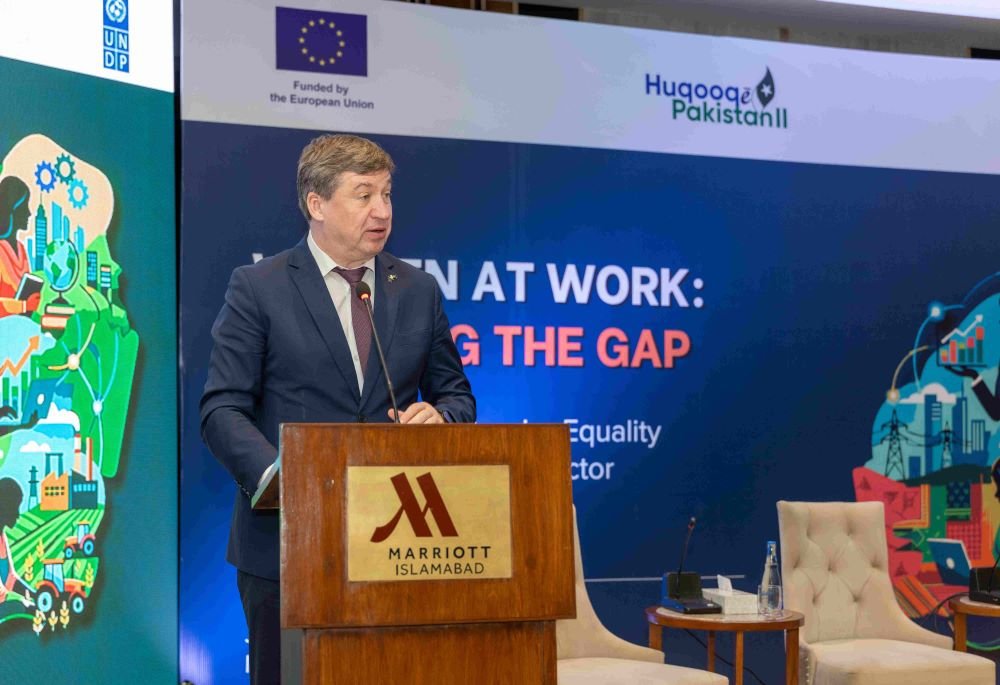
Islamabad (GNP): Raimundas Karoblis, Ambassador of the European Union to Pakistan, highlighted the importance of advancing women’s labour rights and workplace equality, stating that “Gender equality is not only a fundamental human rights issue, but also essential for sustainable economic growth and social progress.”
Moreover, he said, “Strengthening women’s participation in the workforce and ensuring safe and equitable workplaces are closely linked to Pakistan’s international commitments, including under the GSP+ framework. This report provides important evidence and practical recommendations to support continued progress toward inclusive and rights-based economic development.”
Drawing on nationwide consultations, interviews, and a review of workplace policies and institutional frameworks, the report identifies persistent barriers to women’s entry, retention, and advancement in the workforce. These include workplace harassment, limited leadership opportunities, weak implementation of gender-responsive policies, and inadequate protections for women in informal work.
The report calls for coordinated reforms to strengthen labour governance, workplace protections, leadership pathways, supply-chain accountability, worker infrastructure, entrepreneurship support, and access to remedy.
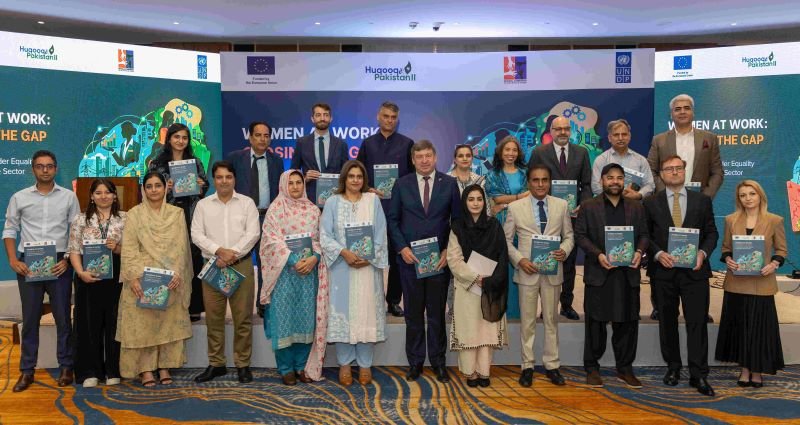
European Union (EU), the National Commission on the Status of Women (NCSW) and the United Nations Development Programme (UNDP) launched “Women at Work: Closing the Gap” – a landmark report examining the state of gender equality in Pakistan’s private sector and outlining practical reforms to strengthen women’s economic participation, workplace protections, and leadership.
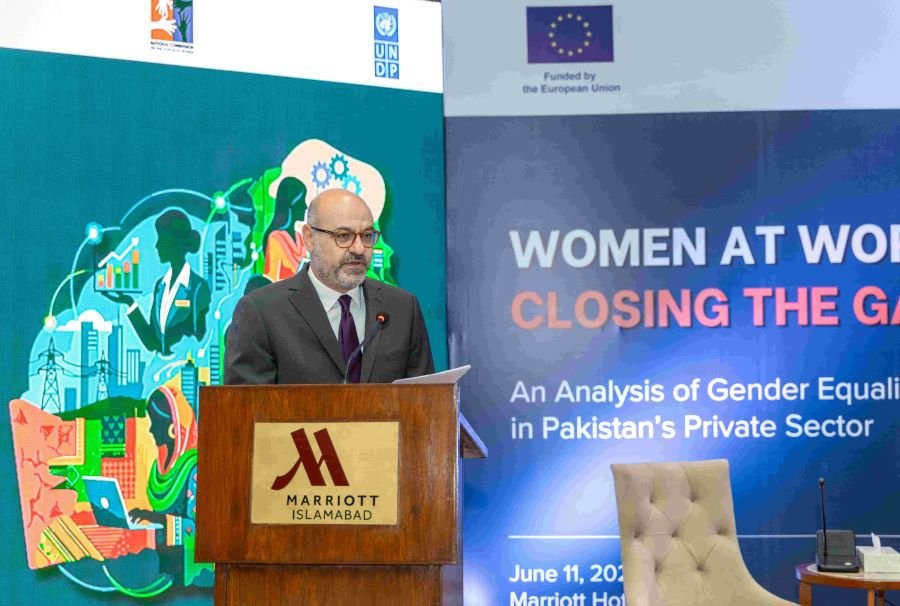
Produced under the EU-funded Huqooq-e-Pakistan II project, the report reveals that women’s labour force participation remains stagnant at around 30 percent despite improvements in education and skills development. The gender pay gap remains above 20 percent, while women continue to be concentrated in low-paid, informal, insecure, and low-authority work.
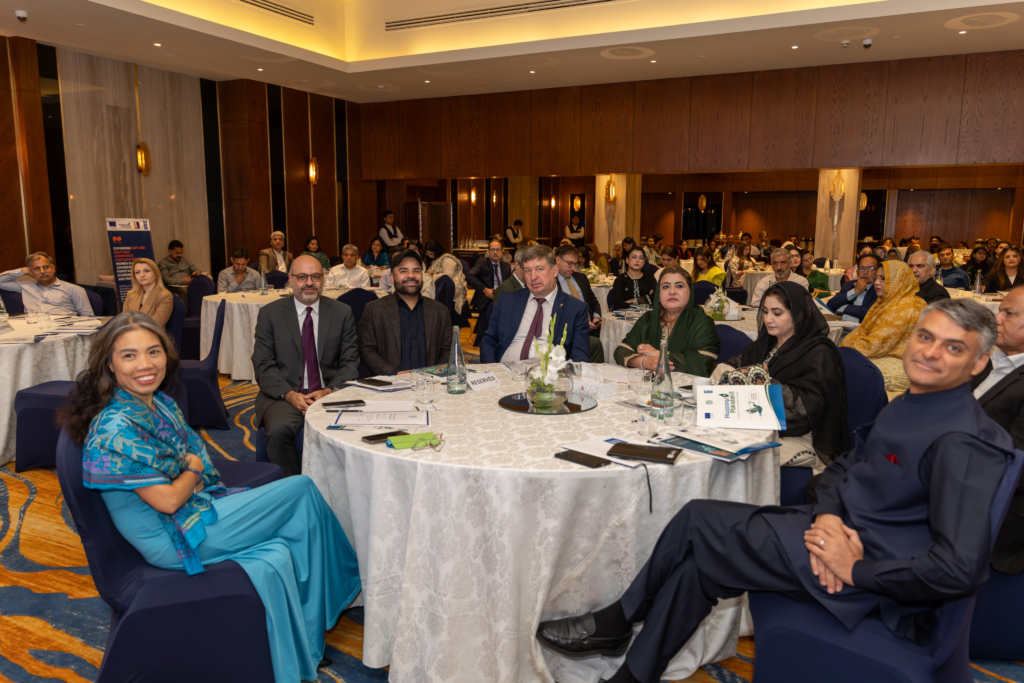
The launch brought together senior government officials, private sector representatives, development and diplomatic partners, labour rights organisations, civil society representatives, and UN agencies to discuss the findings and advance dialogue on building more inclusive and equitable workplaces.
Dr. Samuel Rizk, UNDP Resident Representative, emphasised that, “Women’s economic empowerment is a powerful driver of inclusive growth and sustainable development. Pakistan cannot fully realise its development potential while women remain underrepresented in leadership and formal employment. This report underscores the need for coordinated action across government, business, and civil society to remove barriers, expand opportunities, and build a more inclusive economy that works for everyone.”
Noureen Bano Lehri, Chairperson NCSW, reaffirmed the Commission’s commitment to advancing gender equality and women’s economic empowerment, describing the report as, “an important step toward identifying practical and actionable measures to address gender disparities in Pakistan’s private sector. NCSW will continue to work closely with government institutions, the private sector, development partners, and civil society to promote policies and practices that ensure safe, inclusive, and equitable workplaces for women across Pakistan.”
The launch also featured a panel discussion with representatives from the Ministry of Human Rights, the International Labour Organization (ILO), the Federation of Pakistan Chambers of Commerce and Industry (FPCCI), and the private sector, focusing on how institutions can translate policy commitments into measurable workplace outcomes for women.
Barrister Aqeel Malik, Minister of State for Law and Justice, appreciated the report, stating, “The report’s recommendations align with the National Action Plan on Business and Human Rights, which identifies gender equality as a priority area, and provide valuable evidence to guide future action.”
Also Read: Sialkot Airport is a Symbol of Visionary Leadership, Mary
He called for continued collaboration among government, businesses, and development partners to address workplace barriers and promote inclusive economic development.
The launch marks an important milestone under the Huqooq-e-Pakistan II project, reinforcing joint efforts by the EU, UNDP, and NCSW to advance gender equality, strengthen rights-based governance, and promote inclusive economic opportunities through evidence-based policymaking and multi-stakeholder collaboration.

Sohail Majeed is a Special Correspondent at The Diplomatic Insight. He has twelve plus years of experience in journalism & reporting. He covers International Affairs, Diplomacy, UN, Sports, Climate Change, Economy, Technology, and Health.