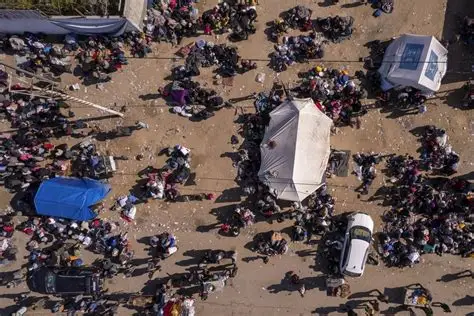
Ramallah (GNP): Middle East Ceasefire Crisis 2026 has reached a critical breaking point, as ceasefires announced across Gaza, Lebanon, and Iran continue to crumble under the weight of relentless military operations, unresolved political disputes, and escalating violence on multiple fronts. Despite repeated announcements of de-escalation agreements, the fighting across the region is intensifying rather than subsiding, raising serious questions about the durability of any diplomatic framework in the current environment.
Middle East Ceasefire Crisis 2026 has exposed the fragility of internationally brokered agreements, as none of the warring parties have officially exited their respective ceasefires, yet the term itself is rapidly losing its meaning on the ground. In Gaza, Israeli forces have continued to capture territory and conduct strikes, killing two top Hamas militants and more than a dozen other people in recent weeks.
Israel controls approximately 60 percent of Gaza, compared to around half when the ceasefire was originally signed, with Prime Minister Benjamin Netanyahu recently stating that Israel planned to extend its control to 70 percent of the territory.
United States Secretary of State Marco Rubio told lawmakers on Tuesday that Netanyahu’s statement does not reflect Washington’s plan for ending the conflict, highlighting the growing divergence between Israeli military objectives and American diplomatic goals in the region.
While the October ceasefire in Gaza ended two years of full-scale hostilities and brought about the release of all remaining hostages taken during Hamas’ October 7, 2023 attack, no meaningful progress has been made on any of the broader political objectives. Hamas has yet to disarm, Israeli troops have advanced rather than withdrawn, an international stabilization force has yet to materialize, a new Palestinian administration remains in limbo, and reconstruction of the largely flattened territory has not yet begun.
Hundreds of thousands of Palestinians remain in squalid tent camps, living in conditions of extreme deprivation, with the constant threat of Israeli strikes adding to the daily suffering of a civilian population that has already endured years of devastating conflict. Hamas accuses Israel of repeatedly violating the ceasefire through regular strikes that have killed at least 932 Palestinians, including women and children, since the ceasefire took effect, according to local health officials. Israel and the United States blame Hamas, saying its refusal to disarm has held up the entire peace process.
Also Read: Pakistan Praised for Peace as Mushahid Hails New Global Order
Lebanon Ceasefire Fails to Stop Escalating Violence
The Middle East Ceasefire Crisis 2026 is equally pronounced in Lebanon, where a ceasefire reached in April has had little discernible impact on the fighting between Israel and the Iran-backed Hezbollah movement, particularly in southern Lebanon. Over the weekend, Israeli troops raised their flag over Beaufort Castle, marking their deepest military incursion into southern Lebanon since the end of the 1982 to 2000 occupation.
Hezbollah responded to the Israeli advance with even deeper rocket attacks into northern Israel, demonstrating that the ceasefire framework has failed to prevent either side from escalating its military activities. Israel has stated that it will continue fighting until the threat of rocket and drone attacks on its northern communities has been eliminated, either through its own military operations or through the Lebanese government disarming Hezbollah — an outcome that appears increasingly unlikely given the current trajectory of events.
US President Donald Trump announced on Tuesday that both sides had agreed once again to de-escalate, but the fighting on the ground showed no immediate sign of responding to diplomatic pressure.
US and Iran Continue Trading Fire
The Middle East Ceasefire Crisis 2026 extends beyond Gaza and Lebanon to the broader confrontation between the United States and Iran. A wider ceasefire reached in early April between the United States, Iran, and Israel was intended to end the regional war and reopen the Strait of Hormuz, a critical maritime chokepoint whose closure caused global oil prices to spike and inflicted severe economic pain far beyond the immediate region.
Iran initially announced the reopening of the strait following the ceasefire but moved to close it again after the United States imposed a naval blockade on Iranian ports. The two sides have continued trading fire in and around the strait, with the United States acting to eliminate what it describes as threats to commercial shipping and its own naval forces, and Iran retaliating with missile and drone attacks on Gulf countries hosting American military personnel.
The United States bombed military sites in Iran on Monday and Tuesday after Tehran shot down an American drone over the weekend. Iran said in response that it targeted American soldiers in Kuwait and Bahrain with missiles, which the United States stated it successfully intercepted. United States Central Command stated that it would continue to protect its forces from Iranian aggression while supporting the ongoing ceasefire.
The two sides appeared close to a broader deal last week but did not reach one. Trump has repeatedly threatened to resume full-scale war if Iran does not give up its stockpile of highly enriched uranium, while Iranian officials have insisted they will not discuss nuclear issues until a more durable truce is first established.
The current cycle of conflict across the Middle East traces its origins to Hamas’ October 7, 2023 attack on Israel, which triggered a devastating Israeli military campaign in Gaza. The conflict subsequently expanded to involve Hezbollah in Lebanon, Iran, and American military forces in the region, creating one of the most complex and dangerous multi-front conflicts the Middle East has seen in decades. Despite repeated international efforts to broker lasting ceasefires, the fundamental political and security disagreements between the parties involved have so far prevented any durable resolution.