
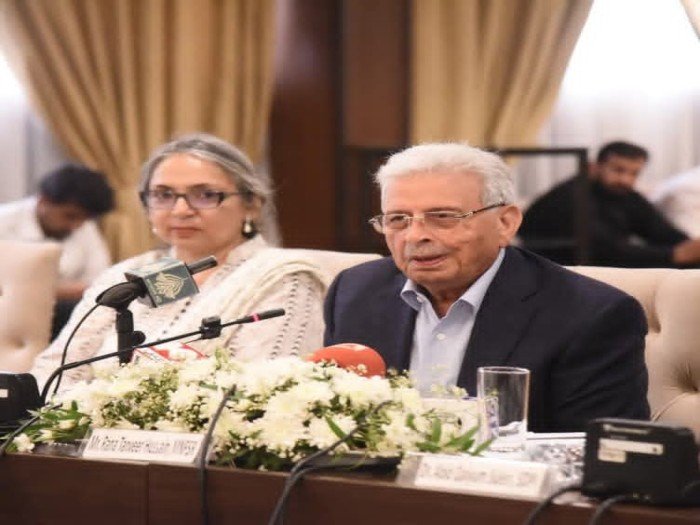
Islamabad (GNP): Federal Minister for National Food Security and Research Rana Tanveer Hussain has reaffirmed the government’s resolve to pursue public health, social protection, and economic development as complementary rather than competing priorities.
The Minister was addressing a pre-budget consultation convened by the Fruit Juice Council, where he threw his weight behind the industry’s call for reduced taxation on fruit-based and no-added-sugar beverages.
He said that the current level of taxation was weighing heavily on production, investment, and export performance, and argued that value-added products deserved policy support to sharpen Pakistan’s competitive edge in global markets.
“Our exports can only grow through better quality and competitive products. Value-added products must be encouraged,” he said, signalling the government’s willingness to explore relief measures for productive sectors even within tight fiscal space.
Participants at the consultation were united in proposing that the existing 20 per cent Federal Excise Duty (FED) on fruit juices be brought down to 10 per cent, and that beverages with no added sugar be exempted from FED entirely. They contended that such a policy shift would promote healthier consumer behaviour, benefit farmers, attract investment, drive exports, and support broader economic growth.
Dr. Abid Qaiyum Suleri, Executive Director of the Sustainable Development Policy Institute (SDPI), made a case for a more nuanced tax policy framework. He argued that if the intent behind taxing sugary drinks is to protect public health, then the policy must draw a clear distinction between products based on their nutritional profile.
Beverages with minimal added sugar and higher fruit content, he said, should carry a lighter tax burden than high-sugar drinks. He further recommended that revenues collected through health-related levies be earmarked transparently for healthcare expenditure so citizens can see a tangible return.
Waqar Ahmed of the Fruit Juice Council pressed for a zero-FED classification for the no-added-sugar category, saying it was fundamentally unjust to apply the same rate to a pure fruit juice as to a heavily sweetened drink.
He said the industry had long championed a tiered taxation model that accounts for the fruit content and nutritional value of juice products, many of which contain between 5 and 100 per cent fruit content and are produced under rigorous food safety regulations, unlike much of the informal sector.
He cautioned that a blanket 20 per cent FED would stifle innovation in healthier product lines and noted that the formal juice industry’s annual turnover had already contracted sharply, from approximately Rs 60 billion to around Rs 40 billion, as a direct consequence of successive duty increases.
Zainab Naeem, Head of the Ecological Sustainability and Circular Economy Unit at SDPI, reinforced this view, arguing that applying a uniform FED across beverages with vastly different sugar compositions was both economically damaging and counter-productive from a health standpoint.
She noted that treating a carbonated drink with maximum sugar content the same as a fruit juice with a fraction of that sugar would penalise the very products the government should be incentivising.
Also Read: Italy Opens 10,500 Job Opportunities for Pakistanis, Marilina
Aatekah Mir Khan, also representing the Fruit Juice Council, provided a broader picture of the industry’s economic footprint, noting that council members collectively hold around 75 per cent of the formal juice market.
She said the sector sustains an extensive value chain spanning farmers, processors, manufacturers, and distributors, with roughly 58 per cent of the value it generates flowing to various stakeholders along that chain.
She also pointed out that taxes already account for close to 42 per cent of the retail price of a juice pack, a burden she described as unsustainable. She added a further warning that punitive taxation risks pushing price-sensitive consumers toward cheaper, unregulated alternatives that lack quality controls and often contain harmful additives.
Nadia Tahir, an economic expert from the Prime Minister’s Office, rounded out the discussion by urging the industry to prioritise export expansion, product quality, and regulatory compliance as the pathway to realising Pakistan’s considerable untapped potential in processed fruit exports.

Sohail Majeed is a Special Correspondent at The Diplomatic Insight. He has twelve plus years of experience in journalism & reporting. He covers International Affairs, Diplomacy, UN, Sports, Climate Change, Economy, Technology, and Health.