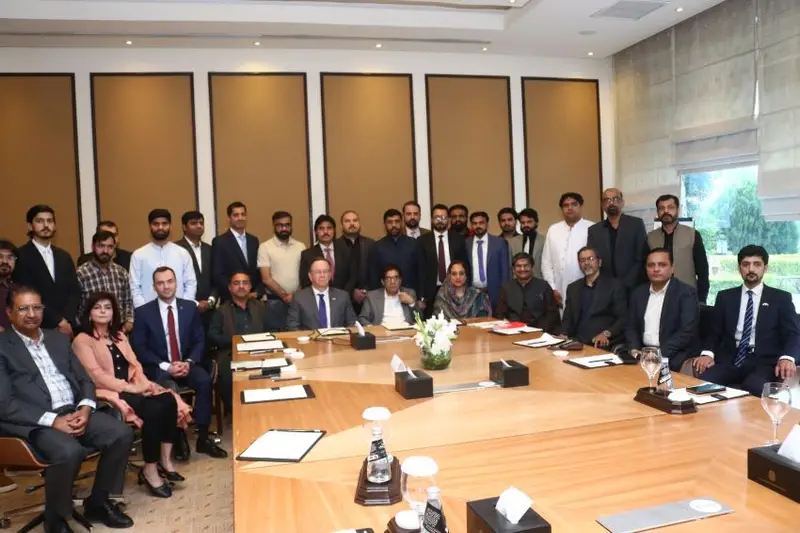
Islamabad (GNP ) : A business forum titled “Exploring Business Opportunities in Poland” was held to bringing together key stakeholders to promote economic cooperation and strengthen trade ties between Pakistan and Poland.
Jointly organized by the Pakistan–Poland Business Council of the Federation of Pakistan Chambers of Commerce and Industry and the Global Business Alliance (GBA), the event served as a platform for dialogue aimed at translating bilateral engagement into tangible economic collaboration.
The session featured prominent speakers including Arif Malik, Chairman of the Pak-Poland Business Council, Maciej Pisarski, Ambassador of Poland to Pakistan, and Pawel Mokrzycki, Economic Secretary of the Embassy of Poland. The forum highlighted that both nations are experiencing steady growth, particularly in the textile sector, and emphasized that Poland’s position within the European Union offers a structured and predictable legal environment for Pakistani businesses to access the wider European market.
Arif Malik opened the proceedings by characterizing Poland as one of the fastest-growing countries in Europe, offering immense potential for Pakistani trade and investment. He identified key sectors for synergy, including textiles, IT, and agriculture, noting that the current session was vital for both nations to understand each other’s strengths. Malik stressed the importance of building long-term connections and shifting the focus from dialogue to “practical collaboration.”
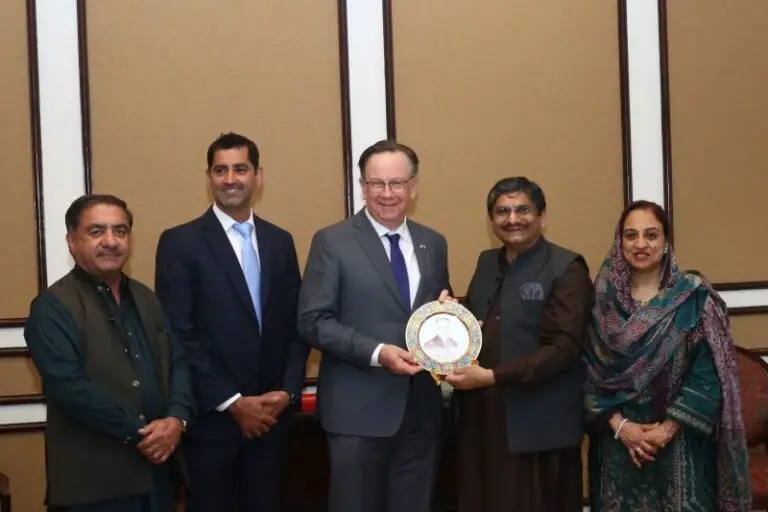
This sentiment was echoed by Chairperson Diplomatic Insight Group and the moderator of the session Dr. Farhat Asif, who discussed the role of GBA in facilitating multi-sector delegations, such as a recent 2024-25 mission to Morocco that achieved $2.3 million in investment, serving as a model for future Pakistan-Poland match-making and business understanding.
Maciej Pisarski provided a deep historical and strategic context for the relationship, tracing the bond back to the era before Pakistan’s independence when more than 23,000 Polish refugees found shelter in Karachi during World War II. He noted that these “people-to-people” connections were foundational, citing the contribution of Polish officers to the building of the Pakistani nation and its forces.
While formal diplomatic relations began in 1962, the relationship has evolved significantly following Poland’s integration into the EU, he said. The Ambassador revealed that bilateral trade reached $1.03 billion last year, crossing a major threshold; however, he characterized this as “just a beginning.”
He highlighted a significant challenge in the trade imbalance, noting that while Poland exports steel, iron, and coal, Pakistan’s exports remain concentrated in textiles, gloves, and footballs. To address energy security, the Ambassador highlighted a massive $500 million Polish investment in gas exploration within Pakistan. This project utilizes unique extraction technology to bring Pakistani gas to the local market, directly contributing to the country’s energy infrastructure.
Pawel Mokrzycki, Economic Secretary at the Embassy of Poland in Pakistan, delivered a detailed presentation on the Polish economy, emphasizing that its greatest asset is its “highly educated human capital.” He shared that 24% of the young workforce (aged 25-35) holds higher education degrees, making Poland a highly competitive workforce in Europe. This talent pool has attracted global giants like Microsoft, which invested over $1 billion in data centers, Google, which invested over $2 billion, and Samsung, which operates its largest R&D center outside of Korea in Warsaw.
Mokrzycki explained that Poland’s strategic location in the center of Europe, combined with its dense transport infrastructure of roads, rail, and seaports, has turned the country into a premier logistics hub for the continent. He emphasized that Poland’s diversified economy is a “strength,” as it remained resilient and avoided recession during various global economic crises.
In the technology sector, Mokrzycki detailed an IT landscape featuring 300,000 software developers and over 1,300 software houses, including global players like Comarch and Asseco. He highlighted the success of Polish “unicorns” such as Allegro and Booksy, as well as the world-famous video game industry responsible for titles like The Witcher and Cyberpunk. A major area for future cooperation is FinTech, where Poland is a European leader with 70% of payments being digital (over 15 billion transactions annually).
Mokrzycki proposed conducting webinars for Pakistani administration and businesses to help digitize the informal sector and increase the tax base. Furthermore, he highlighted Poland’s Agri-food strength, noting nearly $60 billion in annual exports and Poland’s status as a major producer of Halal meat (poultry, beef, lamb). Beyond products, Poland offers a “whole package” including food processing machinery and cold storage solutions.
The forum concluded with the remarks of a look at industrial and environmental technologies. Poland offers centuries of expertise in underground mining and mineral extraction (coal and copper), including advanced machinery and safety systems. Mokrzycki drew a comparison between Polish mines and the Khewra Salt Mine in Punjab, showing how Poland revitalizes post-industrial sites into UNESCO heritage attractions.
The presentation also touched upon Green Technologies, including wastewater management and waste-to-energy systems, as well as Poland’s leading role in the automotive, furniture, aviation, and pharmaceutical industries. Raziq, Vice President of FPCCI, closed with remarks acknowledging the spectrum of opportunities and the Embassy’s willingness to help Pakistani counterparts engage with Polish business partners to ensure a mutually profitable future.

Sohail Majeed is a Special Correspondent at The Diplomatic Insight. He has twelve plus years of experience in journalism & reporting. He covers International Affairs, Diplomacy, UN, Sports, Climate Change, Economy, Technology, and Health.