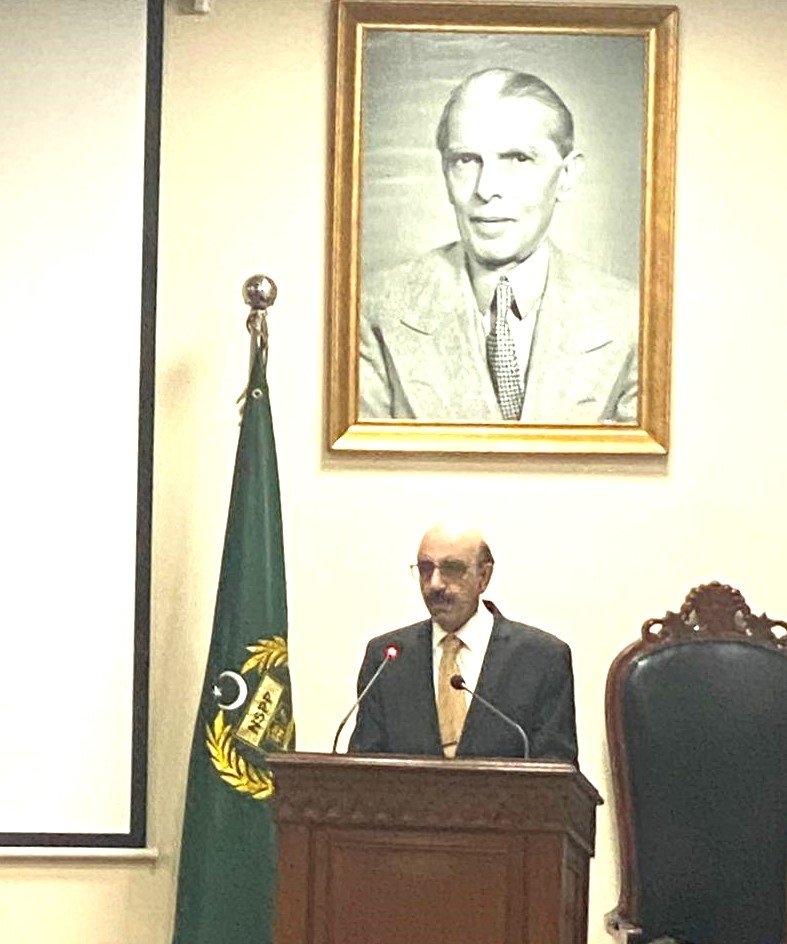
Islamabad (GNP):- Sardar Masood Khan, former President of Azad Jammu and Kashmir and former Ambassador of Pakistan to the United States and Permanent Representative to the United Nations, has stated that Pakistan initially pursued diplomacy and engagement with the Afghan Taliban but was compelled to undertake targeted counter-terrorism operations after repeated terrorist attacks originating from Afghan territory.
Speaking during a television interview on the evolving security situation in the region, Ambassador Masood Khan said that since 2021 Pakistan had consistently tried to resolve the issue through diplomatic channels after the revival of Tehrik-e-Taliban Pakistan (TTP), which began using Afghan soil to carry out attacks against Pakistan.
He said that Pakistan first opted for bilateral diplomacy, negotiations and engagemenfft with the Afghan Taliban, while also advocating internationally for their recognition and legitimacy. “Pakistan extended support to stabilize Afghanistan and hoped that cooperation would lead to regional peace and security,” he added.
Ambassador Masood Khan noted that when bilateral negotiations failed to produce results, Pakistan sought mediation through friendly countries. He referred to China’s role in facilitating dialogue between the foreign ministers of Pakistan and Afghanistan, hosted by Chinese Foreign Minister Wang Yi, where a constructive agenda for regional connectivity and economic cooperation was proposed.
The proposed framework included extending the China-Pakistan Economic Corridor (CPEC) to Afghanistan and integrating the country into the Belt and Road Initiative to promote infrastructure development and regional prosperity. However, he observed that despite Pakistan’s full support for the initiative, the Afghan side did not embrace the proposal.
He further said that Pakistan also explored mediation through Qatar and Turkey during the past year, but these efforts failed to produce meaningful outcomes as commitments made by Afghan Taliban leaders were not implemented.
Ambassador Masood Khan said that despite repeated assurances and religious decrees issued by the Taliban leadership against attacks on Pakistan, terrorist groups including TTP, Daesh and remnants of Al-Qaeda continued to target Pakistan, resulting in the loss of thousands of civilian and security personnel lives.
“In response, Pakistan launched carefully calibrated and targeted counter-terrorism operations aimed solely at terrorist hideouts and training facilities,” he said, adding that these actions were defensive in nature and undertaken after aggression emanating from Afghan territory.
He emphasized that Pakistan’s strategy is based on a two-pronged approach combining diplomacy and counter-terrorism. While maintaining its moral and diplomatic high ground, Pakistan would continue engaging Afghanistan through intermediaries such as China and Qatar, seeking verifiable commitments and credible guarantees that Afghan soil would not be used for terrorism.
Ambassador Masood Khan also expressed concern over external interference in the region, particularly the role of India in exacerbating tensions between Pakistan and Afghanistan through proxy elements.
He concluded that Pakistan remains committed to diplomacy as the ultimate path to peace but will continue to exercise its right to self-defence while ensuring that all its responses remain proportionate and consistent with international humanitarian law.

Sohail Majeed is a Special Correspondent at The Diplomatic Insight. He has twelve plus years of experience in journalism & reporting. He covers International Affairs, Diplomacy, UN, Sports, Climate Change, Economy, Technology, and Health.