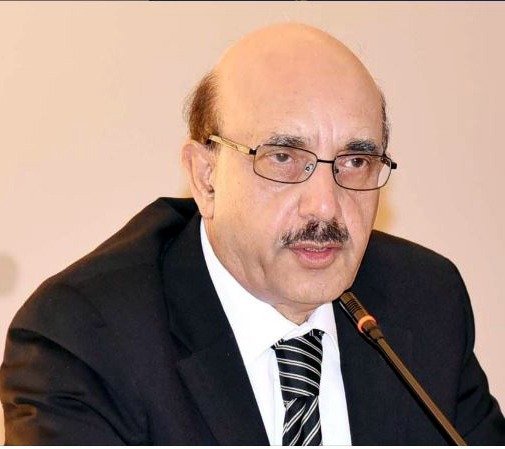
Islamabad : Ambassador Masood Khan, Former President of Azad Jammu and Kashmir and former Ambassador of Pakistan to the United States and Permanent Representative to the United Nations, has stated that the recent visit of Indian Prime Minister Narendra Modi to Israel reflects the consolidation of an already existing strategic framework between New Delhi and Tel Aviv, particularly in the domains of defence production, advanced technology, and regional geopolitics.
Ambassador Khan observed that India and Israel are not merely bilateral partners but operate within broader strategic configurations, including the I2U2 grouping and other Western-aligned frameworks. He noted that discussions during the visit point toward the signing of a special strategic agreement—comparable to arrangements Israel maintains with countries such as the United States and Germany—which would further institutionalize defence cooperation, including drones, air defence systems, and joint production.
Referring to reports of enhanced military collaboration, Ambassador Khan cautioned that Pakistan cannot overlook the fact that in previous confrontations, India deployed Israeli-origin equipment against Pakistan. “We are not anxious,” he remarked, “because Pakistan has built several perimeters of firewalls by strengthening its deterrence capabilities and expanding strategic partnerships. . However, prudence demands vigilance.”
Commenting on Israeli rhetoric about countering so-called “radical axes,” Ambassador Khan noted that while Israeli leadership has moderated its public tone regarding Pakistan, latent hostility cannot be discounted. He warned that Prime Minister Modi’s engagement in Tel Aviv could reinforce adverse perceptions about Pakistan within certain Israeli policy circles, potentially encouraging deeper intelligence-sharing and defence coordination between India and Israel. Nevertheless, he emphasized that Pakistan does not currently perceive an immediate or direct military threat emanating from this visit.
Ambassador Khan also analyzed the evolving Middle Eastern landscape, highlighting Pakistan’s strengthened ties with the US, China, Türkiye, and the Strategic Military Defence Agreement (SMDA) signed with Riyadh. He noted that regional realignments are underway and that Pakistan must continue consolidating its partnerships while pursuing balanced diplomacy. He underscored Pakistan’s constructive role in regional de-escalation efforts, including quiet diplomatic engagement aimed at preventing wider conflict involving Iran and the United States.
Turning to Pakistan’s participation in the Board of Peace, Ambassador Khan categorically rejected any suggestion that Islamabad’s engagement legitimizes Israeli policies or weakens Pakistan’s stance on Palestine or Kashmir. “Joining a diplomatic forum does not constitute endorsement of occupation, annexation, or collective punishment,” he stated. He reaffirmed that Pakistan has drawn clear red lines: no participation in combat operations against Palestinians, no involvement in disarmament campaigns targeting Palestinian people , and insistence on free and unhindered humanitarian corridors.
Ambassador Khan reiterated that the ultimate objective of Pakistan’s diplomacy remains the realization of a sovereign and independent State of Palestine, based on pre-1967 borders, living side by side with Israel in accordance with United Nations resolutions. At the same time, he stressed that Pakistan’s principled support for Palestinian self-determination in no way dilutes its steadfast commitment to the right of self-determination of the people of Jammu and Kashmir.
“Regional alliances are shifting and strategic equations are evolving,” Ambassador Masood Khan concluded. “Pakistan’s approach is clear: we will safeguard our national security, strengthen responsible partnerships, and pursue principled diplomacy rooted in international law and sovereign equality.”

Sohail Majeed is a Special Correspondent at The Diplomatic Insight. He has twelve plus years of experience in journalism & reporting. He covers International Affairs, Diplomacy, UN, Sports, Climate Change, Economy, Technology, and Health.