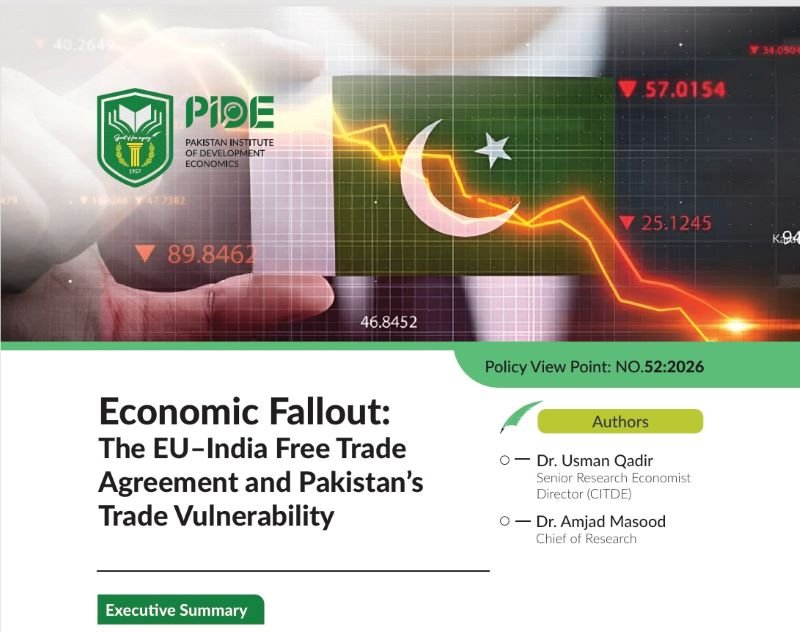
Islamabad :– Pakistan Institute of Development Economics (PIDE) has cautioned that the recently concluded European Union–India Free Trade Agreement (FTA) could significantly heighten Pakistan’s trade vulnerability, particularly in the textile and apparel sector, which forms the backbone of the country’s exports to the European Union. In a new Policy View Point titled “Economic Fallout: The EU–India Free Trade Agreement and Pakistan’s Trade Vulnerability”, PIDE highlights that the agreement marks a structural shift in the regional trade landscape, with serious implications for Pakistan’s market access in its single most important export destination.
The study notes that the EU currently absorbs roughly one-third of Pakistan’s total merchandise exports, most of which enter under the EU’s Generalised Scheme of Preferences Plus (GSP+). While GSP+ has supported export growth over the past decade, it remains unilateral, conditional, and subject to periodic review. In contrast, the EU–India FTA grants India permanent, treaty-based access with extensive tariff reductions and deeper regulatory cooperation, a development that is expected to raise India’s exports to the EU by more than 20 percent and intensify competitive pressure on Pakistani exporters.
PIDE’s analysis finds that the risks are most acute in textiles and apparel, which account for nearly 80 percent of Pakistan’s exports to the EU. With export profiles between India and Pakistan overlapping in several key product categories, the erosion of Pakistan’s preferential margin could lead to trade diversion, reduced market share, and heightened pressure on employment in major industrial clusters such as Faisalabad, Karachi, and Sialkot. The impact is expected to be disproportionately severe for small and medium enterprises, which face limited capacity to absorb cost shocks or undertake rapid upgrading.
The View Point further emphasizes that Pakistan enters this new trade environment with significant structural disadvantages, including the highest energy tariffs among regional competitors, elevated interest rates, and an unpredictable tax and refund regime. These factors undermine firm-level competitiveness and weaken Pakistan’s ability to respond effectively to intensified competition from India, whose export base is far more diversified and resilient.
PIDE underscores the need for coordinated policy action to mitigate potential losses. The View Point calls for short term measures to ease liquidity constraints for exporters, rationalize energy costs, ensure predictable access to GSP+ preferences, and support productivity-enhancing investments. Over the medium to long term, it stresses the importance of securing more durable market access arrangements with the EU, diversifying export markets, and strengthening Pakistan’s integration into regional and global value chains.
The Policy View Point has been authored by Dr. Usman Qadir, Senior Research Economist and Director at PIDE’s Centre for International Trade and Development Economics (CITDE), and Dr. Amjad Masood, Chief of Research at PIDE. It forms part of PIDE’s ongoing efforts to provide evidence-based policy guidance on emerging global economic developments and their implications for Pakistan.