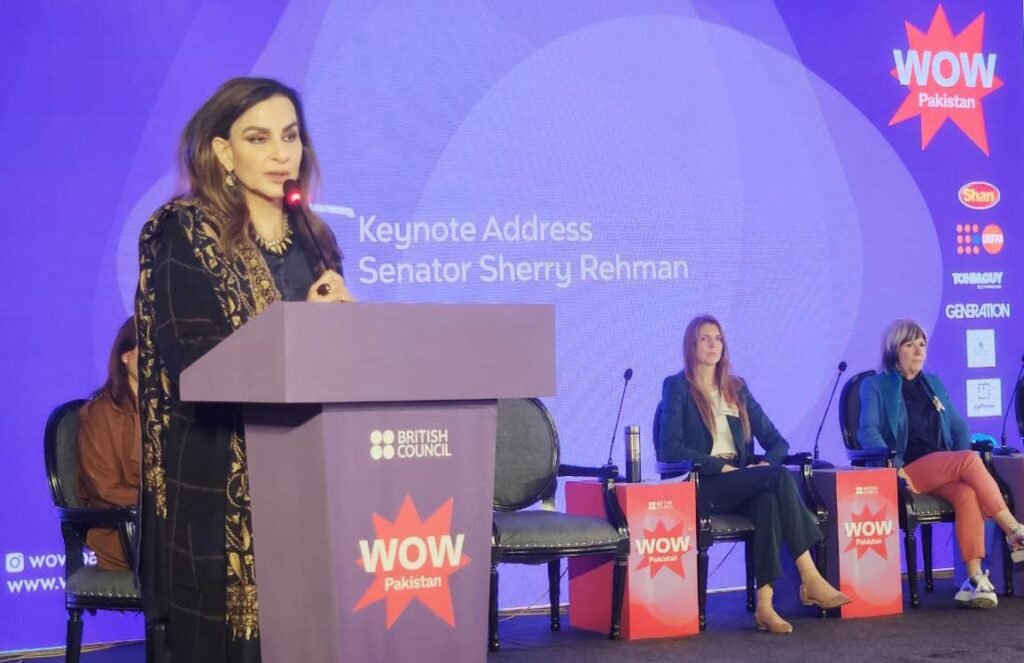
Karachi :— Vice President of the Pakistan Peoples Party Senator Sherry Rehman called for a decisive expansion of women’s political, economic, and social space, warning that climate change, inequality, and weak implementation of laws continue to disproportionately affect women and girls across Pakistan.
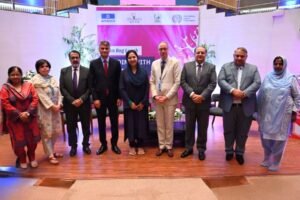
She said this during her keynote at the WOW Conference organized by the British Council under the topic “Expanding Women’s Space in a Decade of Resilience and Climate Challenges,” Senator Rehman began by drawing attention to what she termed the feminisation of injustice.
“In every disruptive frontline — conflict, pandemic, climate catastrophe, or digital warfare — women and children are disproportionately harmed. And the harm is not always collateral. Far too often, it is deliberate,” she said. “Many of us have come to realize that if there is one thing the traditional ‘rights of man’ project still strategically tolerates, it is the universality of the feminization of injustice.”
She reminded the audience that women’s rights have never been gifted through benevolent democratic evolution. “Even in the oldest democracies, women secured the right to vote only after force-feeding, imprisonment, and public vilification. Pakistan’s own women’s movement, which peaked at the turn of the last century, faced arrests, lashings, and systemic indignities under authoritarian laws,” she said, noting that these laws were only partially reversed when Benazir Bhutto’s party, and later other democratic forces, came to power.
Referring to Shaheed Benazir Bhutto, Senator Rehman said her assassination by terrorists during the 2007 election campaign was a tragic reminder of the price women pay for challenging the norms. Her journey underscores one truth: women have never been handed rights as part of some benevolent democratic continuum. Quite the opposite.”
Turning to gender parity as unfinished business, Senator Rehman said that since the Beijing Platform for Action was signed by 189 governments in 1995, progress has remained deeply uneven. “The United Nations tells us that at current global trends, gender parity in political leadership is still 130 years away,” she said.
Reflecting on her own parliamentary journey since 2002, she noted that while legislation mandating women’s political participation for political parties eventually became law, many critical protections took far longer. “The Harassment at the Workplace law took four years. The Child Marriage Restraint law took nine. The Domestic Violence law took twenty-one years,” she said. “This taught us that progress is rarely linear. Someone else may pass the law you began, but women — always women — keep the flame alive. And legislation without implementation remains cosmetic.”
Senator Rehman underscored that women constitute 49.2% of Pakistan’s population, yet their political representation stands at just 17%, despite women contributing nearly 50% of parliamentary work. “This is a clear gap between contribution and authority,” she said. At the global level, women hold only 27.2% of parliamentary seats, and only 29 countries currently have women heads of government.
Addressing economic participation, she said Pakistan’s female labor force participation rate remains at 22.7%, even though women make up 45% of the agricultural workforce. “Yet women own only 2% of agricultural land. This is a structural injustice that limits economic empowerment and decision-making,” she said, adding that 72% of water collection in Pakistan is carried out by women and girls, significantly increasing their unpaid labor burden.
Highlighting the scale of gender-based violence, she revealed that 32,617 cases have been registered nationwide, yet only 5% of perpetrators are convicted, while 64% of cases are dismissed. Nearly 70% of incidents go unreported due to fear, stigma, and lack of institutional trust. “Gender-based violence is not just a women’s issue; it is a question of national security, justice, and governance,” she emphasized.
Senator Rehman also spoke extensively on the gendered impacts of climate change, stating that women and girls are the most affected during climate disasters. Referring to the 2022 floods, she said 1,000 health facilities were destroyed, disrupting services for 650,000 pregnant women, while economic stress pushed 18% more girls into early marriage. She noted that Pakistan’s agriculture sector consumes 90% of national water resources, making climate-resilient and gender-responsive policies imperative.
She underscored key initiatives aimed at women’s empowerment and climate resilience, including the training of 17,000 women in climate-smart agriculture between 2018 and 2022, direct cash transfers to women through the Benazir Income Support Programme, and immediate flood relief measures. She also noted that 2 million homes were allocated in women’s names after the floods, stressing that land and housing ownership significantly enhance women’s autonomy and bargaining power within households and communities.
Calling for systemic reform, Senator Rehman urged mandatory gender analysis in all public policies, the use of gender-disaggregated data, and the meaningful inclusion of women in climate policy formulation and resource allocation. She emphasized that men and boys must be partners in achieving gender equality and cited evidence showing that countries led by women experienced lower COVID-19 mortality rates due to empathetic, science-based governance.
Concluding her address, Senator Sherry Rehman reaffirmed that every girl has the right to complete education, every woman has the right to paid employment, and every woman has the right to live safely — at home, in public spaces, online, and at the workplace. She stressed that women’s representation in public life must be proportional to their population share and that expanding women’s leadership across all sectors is essential to building a resilient, inclusive, and just future for Pakistan.

Sohail Majeed is a Special Correspondent at The Diplomatic Insight. He has twelve plus years of experience in journalism & reporting. He covers International Affairs, Diplomacy, UN, Sports, Climate Change, Economy, Technology, and Health.