Battery Policy 2026–31, A New Pillar of National Energy Security
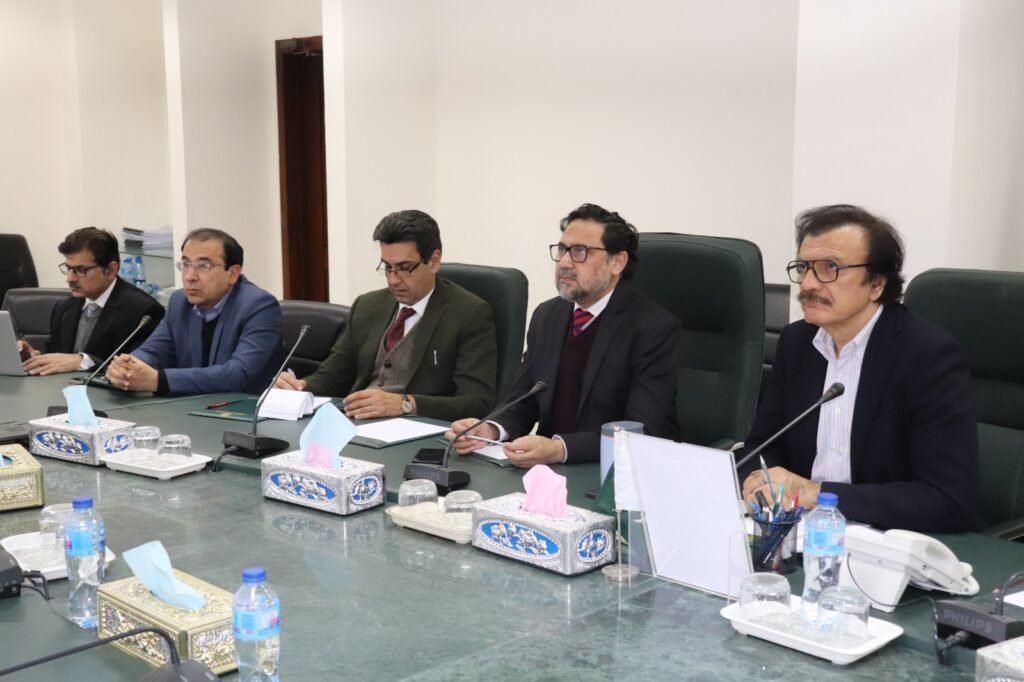
Islamabad : A high-level meeting on the Lithium-Ion Battery Policy was held under the chairmanship of the Special Assistant to the Prime Minister (SAPM) on Industries and Production, Haroon Akhtar Khan. The meeting was attended by Secretary Industries and Production Saif Anjum, CEO Engineering Development Board (EDB) Hammad Mansoor, and representatives of the private sector.
During the meeting, a detailed review was conducted on the progress of the National Lithium-Ion Battery Manufacturing Policy 2026–2031. Haroon Akhtar Khan stated that, in line with the directives of Prime Minister Shehbaz Sharif, the energy storage policy must be integrated with Pakistan’s national energy security framework. He emphasized that, according to the Prime Minister’s vision, partnerships with the private sector and global investors are key to building a sustainable energy future for Pakistan.
The SAPM highlighted that, on the instructions of Prime Minister Shehbaz Sharif, a dedicated Working Group for the National Battery Policy was constituted on 12 December 2025. The committee briefed the meeting that the policy includes phased localization, tariff reforms, and performance-based incentives to promote domestic manufacturing and investment.
Mr. Haroon Akhtar Khan informed participants that the policy has been developed with the support of federal and provincial ministries, industry stakeholders, universities, and international experts. He also noted that Pakistan possesses reserves of phosphate, iron, and manganese in various regions, which can be leveraged to support battery manufacturing and reduce import dependence.
Emphasizing quality and safety, the SAPM said that the role of the Pakistan Standards and Quality Control Authority (PSQCA) is critical in ensuring global standards for battery safety and performance. He added that lithium-ion batteries have wide-ranging applications, including solar energy systems, electric vehicles, backup power solutions, and mobile towers.
The committee approved lithium, iron, and phosphate (LFP) battery technology for initial localization. Mr. Haroon Akhtar Khan stressed the need for a comprehensive framework for battery testing, certification, and recycling to ensure sustainability and environmental protection.
The meeting was also informed that, under B2B cooperation with China, several million-dollar agreements have been signed, including those related to battery manufacturing. Additionally, an important meeting of federal and provincial mineral departments is expected to be held soon to further advance coordination in this sector.
Mr. Haroon Akhtar Khan directed the Engineering Development Board to ensure that the new-generation energy storage policy is fully aligned with national energy security objectives. He further shared that consultations with global experts are underway, reiterating the government’s commitment to transforming Pakistan into a regional hub for battery manufacturing.

Sohail Majeed is a Special Correspondent at The Diplomatic Insight. He has twelve plus years of experience in journalism & reporting. He covers International Affairs, Diplomacy, UN, Sports, Climate Change, Economy, Technology, and Health.