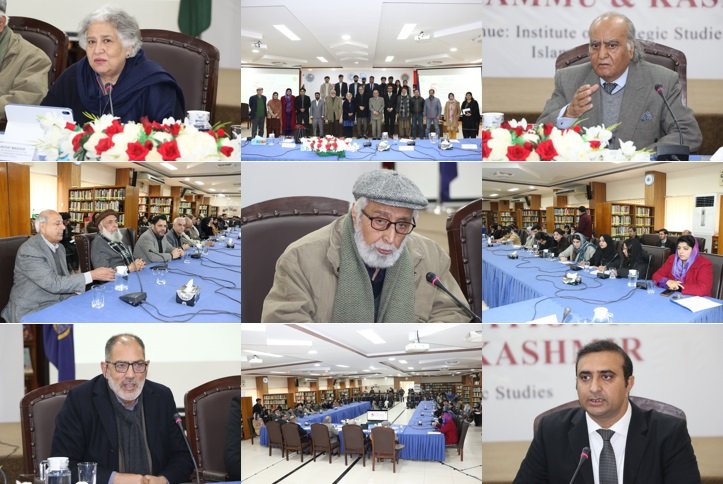
Islamabad : To commemorate and highlight the importance of United Nations Commission for India and Pakistan (UNCIP) resolution of 5th January 1949, the India Study Centre at the Institute of Strategic Studies, Islamabad (ISSI) organised a round table event titled “5 January: The Call for Self-Determination in Jammu and Kashmir” in collaboration with Kashmir Institute of International Relations (KIIR) and All Parties Hurriyet Conference (APHC).
Speaking at the occasion, Chairman Board of Governance, ISSI, Ambassador Khalid Mahmood said that the 5 January 1949 resolution established the principle that the fate of Jammu and Kashmir would be decided by the people of Jammu and Kashmir through a free and impartial plebiscite under the auspices of the United Nations (UN). India used to claim that Jammu and Kashmir is a bilateral issue, and lately, it has started saying that it is an internal issue, as it is an integral part of India. This position is not acceptable for Pakistan, Kashmiris and the international community, who believe that Jammu and Kashmir is not a territorial issue but a matter of the right of self-determination of the people. He highlighted that it was India itself that took the matter to the UN. The UN prescribed the solution which India accepted but later on backtracked. India sometimes says this issue should be settled bilaterally and sometimes says it has already been settled. Pakistan believes that apart from bilateralism, under the UN Charter there are several other peaceful methods of resolving the dispute, like mediation, conciliation, arbitration and judicial settlement. The Jammu and Kashmir dispute is still on the UN agenda, and the presence of UNMOGIP clearly indicates that the issue is still alive and needs resolution. The nuclear dimension, a threat to the peace and stability of the region and the ongoing massive human rights violations of Kashmiris under India occupation, all warrant early resolution of this dispute.
In his introductory remarks, the Director of the India Study Centre, Dr Khurram Abbas, said that on this date in 1949, the UNCIP acknowledged the right of self-determination of the Kashmiri people. However, after almost 78 years, the people of Jammu and Kashmir are still waiting to exercise their right of self-determination. He said that the relevance of this resolution increased manifold post August 5, 2019.
Mr Altaf Hussain Wani, Chairman of the Kashmir Institute of International Relations, Islamabad, said there are a number of UN resolutions on Kashmir, but the UNCIP resolution of 5 January 1949 gave a roadmap towards a solution of the Jammu and Kashmir dispute. India knew from the outset that it would forcefully occupy this princely state with a Muslim majority. It thought that it would go to the UN, saying that the Maharaja had already signed an accession with India and would get Pakistan declared an aggressor. However, the maharaja had already relinquished his authority and fled the region. The UN subsequently decided that the people of Jammu and Kashmir should decide its future. The UN maintained the same position after India tried to mislead the UN by conducting Constituent Assembly elections in the region under its occupation and arguing the elections reflected the will of the people to remain with India. He encouraged the younger generation to understand the Jammu and Kashmir dispute in its true perspective and be future diplomats for the Kashmir cause.
Mr Farooq Rehmani, senior leader and former convener of the All Parties Hurriyet Conference, said that India never wanted to implement UN resolutions and therefore, it complicated the procedure by raising one objection or another. The ceasefire was only intended to bring peace in the region, but India used it to divide Azad Jammu and Kashmir from the Indian Occupied Jammu and Kashmir. He informed that the 1990s era saw one of the worst phases of human rights abuses in the Indian Occupied Jammu and Kashmir. It was the time when unmarked graves were discovered across the occupied region. Post August 2019, India is actively pursuing its agenda of demographic change. Thousands of Domicile Certificates have been distributed among non-Kashmiri Indians, while the Kashmiri leadership is languishing in jails. He stressed that the people of Jammu and Kashmir do not demand restoration of Articles 370 or 35A, rather, they demand the fulfilment of their almost 80-year-old promise of the right of self-determination.
Ambassador Riffat Masood, Pakistan’s Representative to the OIC-Independent Permanent Human Rights Commission (IPHRC), opined that the right of self-determination was an important component of the freedom movement of India and Pakistan from British Raj. It is ironic that after its independence, India was not willing to give the same right to the people of Jammu and Kashmir. Several global examples exist, such as Kosovo, South Sudan, and East Timor, where people have successfully exercised their right to self-determination. Unfortunately, despite being one of the oldest disputes on the UN agenda, the people of Jammu and Kashmir are still waiting to exercise this inalienable right. Today, the people of Jammu and Kashmir are engaged in a struggle for their survival. She highlighted the plight of Kashmiri women, particularly the half-widows. She suggested that Pakistan must mobilise public opinion both within the country and across the globe. She also stressed that the UN Secretary General must appoint a special envoy for the Jammu and Kashmir dispute. She also suggested that Pakistan should explore the possibility of taking Indian Prime Minister Narendra Modi to the International Criminal Court (ICC) for grave human rights violations in IIOJK.
Members of the think tank community, intellectuals, and a large number of students attended the event. While concluding the event, Ambassador Khalid Mahmood saluted the resilience of the Kashmiri people who refuse to give up on the just and principled demand of their right of self-determination. He reiterated Pakistan’s unflinching political, moral and diplomatic support to the Kashmir cause.

Sohail Majeed is a Special Correspondent at The Diplomatic Insight. He has twelve plus years of experience in journalism & reporting. He covers International Affairs, Diplomacy, UN, Sports, Climate Change, Economy, Technology, and Health.