Islamabad : Pakistan on Thursday cautioned India against misusing its limited rights under the Indus Waters Treaty (IWT) for unilateral hydroelectric projects on the western rivers.
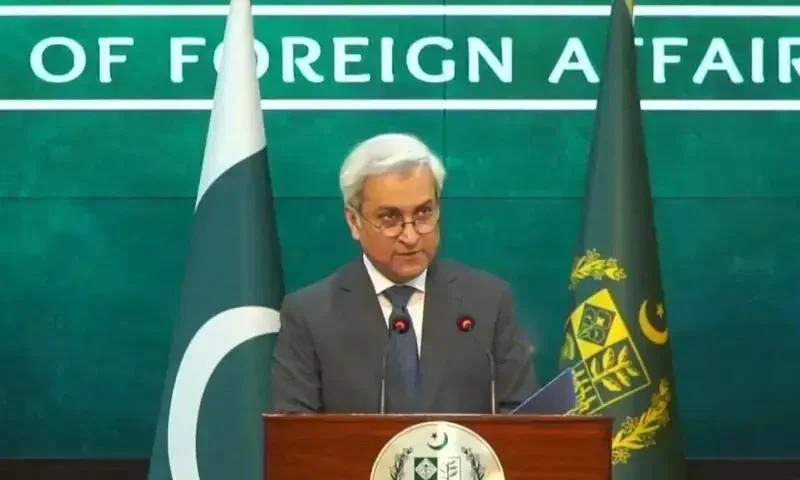
Foreign Office spokesperson Tahir Hussain Andrabi made the remarks while addressing India’s approval of the 260-megawatt Dulhasti Stage-II hydropower project on the Chenab River in Indian Illegally Occupied Jammu and Kashmir.
Andrabi emphasized that, under the IWT, India is required to share prior information with Pakistan regarding any project on the western rivers. “Media reports on India’s plans for the Dulhasti Stage-II project raise serious concerns, as Pakistan was not notified in advance,” he said.
He added that the treaty allows India only a restricted use of water from the western rivers, primarily for hydropower generation, and any project must comply with strict design, operational, and information-sharing rules. “In the absence of formal communication from India, Pakistan cannot assess whether the project conforms to treaty provisions,” Andrabi said, calling on India to respond promptly to queries from the Pakistani Indus Water Commissioner.
Andrabi reiterated that the IWT remains a binding international agreement. “Pakistan remains committed to resolving disputes peacefully but will never compromise on its vital water rights,” he said.
During the briefing, Andrabi also confirmed that Pakistan and India have exchanged official lists of their nuclear installations, as required under the 1988 Agreement on the Prohibition of Attacks Against Nuclear Installations and Facilities. He noted that both countries are obligated to share this information annually.Responding to questions on recent US arms sales to Taiwan, Andrabi reaffirmed Pakistan’s support for China on all matters related to its core interests, including Taiwan. “Pakistan fully adheres to the one-China principle and regards Taiwan as an inalienable part of China,” he said. He urged all countries to respect historical commitments, promote peace and stability, and avoid actions that could escalate tensions in the region.

Sohail Majeed is a Special Correspondent at The Diplomatic Insight. He has twelve plus years of experience in journalism & reporting. He covers International Affairs, Diplomacy, UN, Sports, Climate Change, Economy, Technology, and Health.