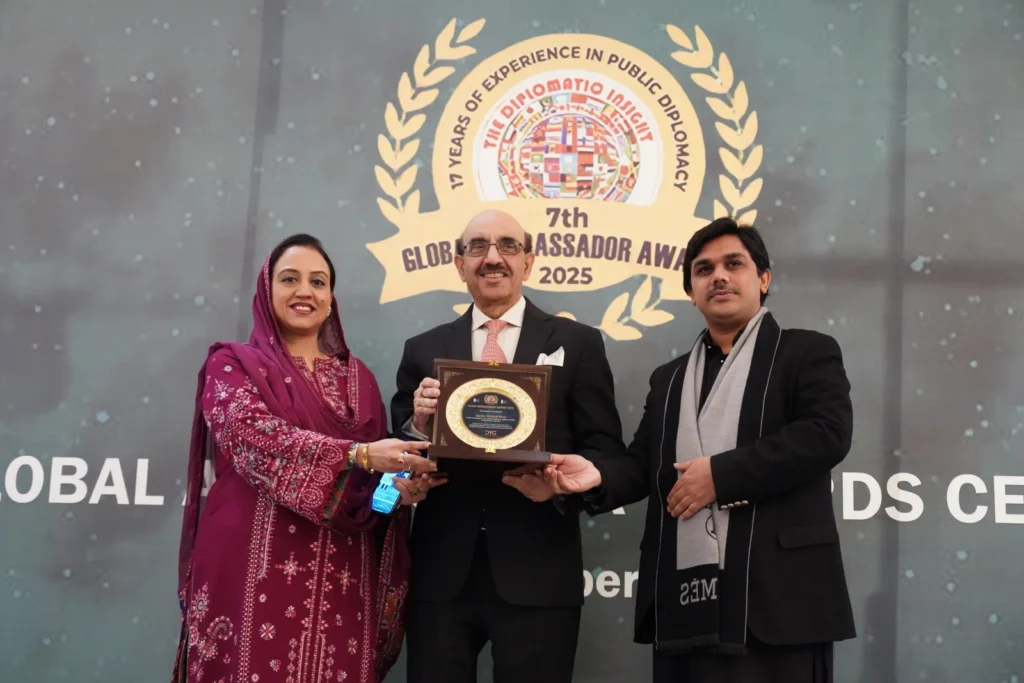
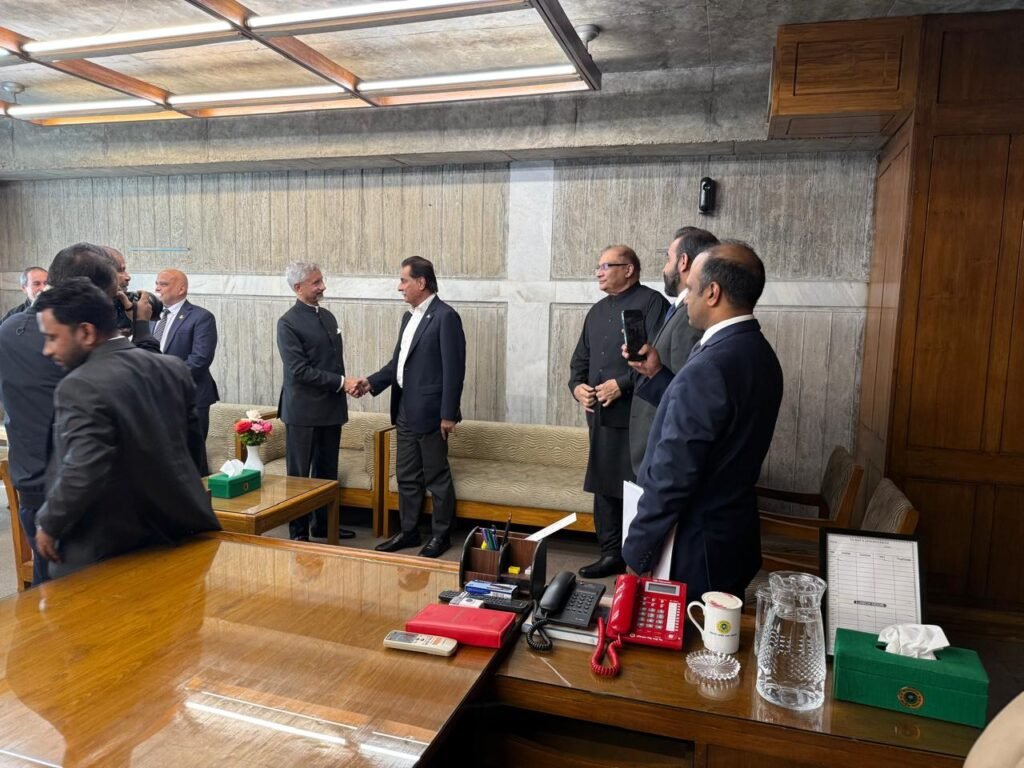
Muzaffarabad : The unexpected yet deliberate handshake and exchange of smiles between Indian External Affairs Minister Subrahmanyam Jaishankar and Speaker of Pakistan’s National Assembly Sardar Ayaz Sadiq marks a significant diplomatic moment that could signal a potential reset in Pakistan–India relations, said Ambassador Masood Khan, former Pakistan Ambassador to the United States and Permanent Representative to the United Nations, while analysing recent developments in a televised discussion.
Ambassador Masood Khan emphasised that such gestures at the highest political levels are rarely coincidental, particularly between two nuclear-armed neighbours with a history of conflict and mistrust. He said the encounter reflects either carefully prepared diplomatic signalling or the culmination of back-channel efforts encouraging engagement between the two countries. “For a sitting foreign minister who previously refused even a handshake to step forward, initiate contact, and exchange pleasantries with Pakistan’s Speaker is not routine protocol — it is politically meaningful,” he noted.
He praised Speaker Ayaz Sadiq as a consensus-builder and dignified statesman, observing that his personal reputation for courtesy and bridge-building may have encouraged Jaishankar to initiate the gesture. “Ayaz Sadiq has always sought reconciliation and moderation in politics. India likely chose a personality who embodies political balance and respect,” Ambassador Khan remarked.
Commenting on regional dynamics, Ambassador Masood Khan observed that India today finds itself increasingly isolated in its neighbourhood. Relations with Bangladesh, Sri Lanka, Nepal, and the Maldives have all experienced significant strain, while domestic polarisation and hard-line narratives have reduced space for diplomacy. He said that in such an environment, New Delhi may be reassessing the costs of hostility with Pakistan and the benefits of restoring at least a workable relationship.
Ambassador Masood Khan underlined that India cannot economically or strategically progress in isolation from its neighbours, just as no country has developed while remaining locked in perpetual confrontation with its immediate region. “Pakistan and India must live side by side for centuries,” he said. “Finding pathways to dialogue and dispute resolution is not a choice — it is a necessity.”
He recalled that similar overt gestures had been unthinkable in the recent past, noting that in 2023 India’s foreign minister had publicly declined a handshake with his Pakistani counterpart, while anti-Pakistan rhetoric in Indian politics and media reached unprecedented levels. The silence of Indian media following the latest handshake, he said, reflected both suppression and difficulty in reconciling this development with entrenched hostility narratives.
Ambassador Masood Khan said that external actors have consistently encouraged Pakistan–India engagement. He noted that the United States, China, and Russia all quietly supported conflict de-escalation during the May war and subsequently encouraged both sides to return to dialogue. He recalled that President Trump, senior US lawmakers, and regional leaders had publicly called for talks, particularly highlighting the Kashmir dispute as central to long-term stability in South Asia.
He added that back-channel diplomacy between Islamabad and New Delhi — through track-two contacts and security interlocutors — has remained active despite periods of visible tension. “Multiple overtures have been made from Pakistan’s side to end cycles of hot and cold conflict,” he said. “This handshake may be part of that continuing process rather than an isolated photo moment.”
Regarding China’s role, Ambassador Masood Khan said Beijing has repeatedly conveyed to both countries that stability in South Asia is in their shared interest. He also referred to renewed diplomatic engagement between India and China at senior levels, noting that both now recognise the costs of prolonged confrontation and external interference in Asian affairs.
Ambassador Masood Khan underscored that the current ceasefire along the Line of Control has largely held, a development he attributed in part to American diplomatic guarantees and mutual recognition of escalation risks. He added that Pakistan’s emerging network of strategic and defence partnerships, including with Gulf states, has also served as a significant deterrent against any misadventure by India.
He cautioned, however, against assuming that one courteous exchange would automatically transform longstanding disputes. India’s rigid doctrinal positions, domestic political environment, and past unilateral actions — particularly regarding Kashmir — remain formidable obstacles to comprehensive peace. “Our issues are complex and deep-rooted. Dialogue is welcome and overdue, but the real test is whether India is prepared for meaningful negotiations grounded in sovereignty, legality, and mutual respect,” he said.
Reflecting on Pakistan’s global standing, Ambassador Masood Khan said that in 2025 Pakistan has gained renewed diplomatic recognition and relevance, expanding relations not only with the United States but also across Western Asia, the Gulf, Turkey, and beyond. He said this broader profile strengthens Pakistan’s position as a serious regional actor and makes dialogue with Islamabad both attractive and necessary for India.
Concluding his remarks, Ambassador Masood Khan said the handshake between Jaishankar and Ayaz Sadiq is symbolically powerful and politically consequential. While it remains to be seen whether it marks the beginning of sustained engagement, it has already challenged entrenched hostilities, demonstrated diplomatic courage, and created space for potential diplomacy. “This could be the beginning of a new chapter — or merely an important gesture,” he said. “What follows in the coming days and weeks will determine whether this moment becomes a turning point or a missed opportunity in Pakistan–India relations.”