
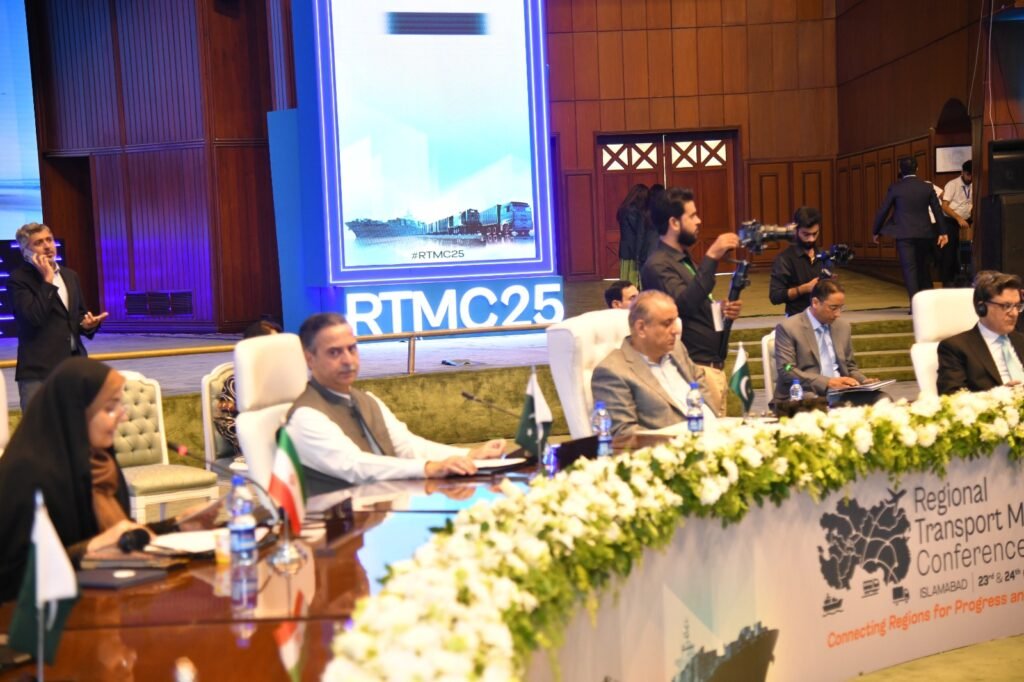
Islamabad: — Federal Minister for Maritime Affairs Muhammad Junaid Anwar Chaudhry has said that Pakistan’s maritime sector is entering a new phase of transformation as the country seeks to become a regional hub of connectivity and trade, driving the growth of the blue economy.
Addressing the Regional Transport Ministers’ Conference, Junaid Chaudhry said Pakistan is engaging with Central Asian, the Gulf Cooperation Council (GCC) countries, and East African nations to strengthen maritime cooperation and expand trade routes.
He noted that Karachi Port and Port Qasim currently operate at only half their capacity, offering vast potential for regional partners. Gwadar Port, equipped with modern transshipment facilities, stands ready to play a central role in regional integration.
The minister projected that Pakistan’s economy could reach one trillion US dollars by 2035, with trade volumes surpassing 250 billion dollars. To support this growth, he said, Pakistan has launched a modern port community system powered by artificial intelligence, while the Pakistan National Shipping Corporation (PNSC) plans to expand its fleet to 30 vessels by mid-2026, contributing up to two percent to GDP.
Junaid Chaudhry termed the revival of the Gaddani ship recycling yard and the establishment of an Integrated Maritime Industrial Complex at Port Qasim as “game changers” for Pakistan’s maritime future. He invited regional counterparts to visit Pakistani ports to witness ongoing advancements in infrastructure and logistics.
He said the conference’s session on Regional Maritime Cooperation and the Blue Economy brought together experts and policymakers from 26 countries to explore the oceans’ role as engines of growth and sustainability. “Our oceans are not barriers but bridges,” he remarked.
Reaffirming Pakistan’s commitment to the UN 2030 Agenda, Minister Chaudhry said the Blue Economy strategy aims to connect the Arabian Sea with the Gulf, Central Asia, East Africa, and South Asia, turning the region into a corridor of prosperity.
He noted that Pakistan’s 1,046-kilometer coastline and 290,000-square-kilometer Exclusive Economic Zone offer immense potential, with plans to raise the maritime sector’s GDP share from 0.8 to two percent by 2035 through innovation and international collaboration.
Outlining a decade-long maritime vision, Junaid Chaudhry said the goal is to build a globally competitive and sustainable maritime industry by 2035 expanding PNSC’s fleet to 80 ships, digitizing ports, and promoting shipbuilding, aquaculture, and coastal tourism.
Highlighting Karachi Port as Pakistan’s leading trade facility, Port Qasim as one of the world’s most developed, and Gwadar as an emerging regional hub, he said improved road and rail connectivity will be completed by 2028, with Gwadar projected to lead in cargo throughput by 2030.
He added that port master plans are being updated with international assistance to align with global standards. Gwadar, supported by its new international airport, is set to become a regional gateway for energy, fiber, and IT connectivity, linking sea trade directly with global air routes.
Concluding, Junaid Anwar Chaudhry said Pakistan’s maritime journey represents a shift “from potential to progress and integration,” reflecting the nation’s resolve to turn its seas into bridges of prosperity.
Representatives from 22 countries participated in the event, including Transport Ministers from Russia, Belarus, Sri Lanka, Maldives, Turkmenistan, Iran, Kazakhstan, Turkey, Uzbekistan, Azerbaijan, and Saudi Arabia, along with delegates from Economic Cooperation Organization (ECO), International Road Transport Union (IRU), Asian Development Bank (ADB), the UN Secretary-General’s Road Safety (UNSG), and the Islamic Development Bank (IsDB).