Islamabad : Ambassador Masood Khan, former President of Azad Jammu and Kashmir and former Ambassador of Pakistan to the United States, China and the United Nations, stated that the people of Jammu and Kashmir continue to suffer incarceration, torture, and systemic repression under Indian occupation, yet remain steadfast in their demand for the realization of their right to self-determination.
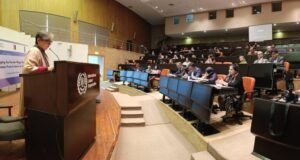
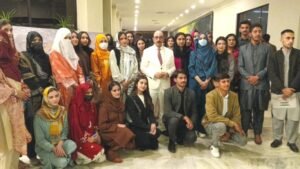
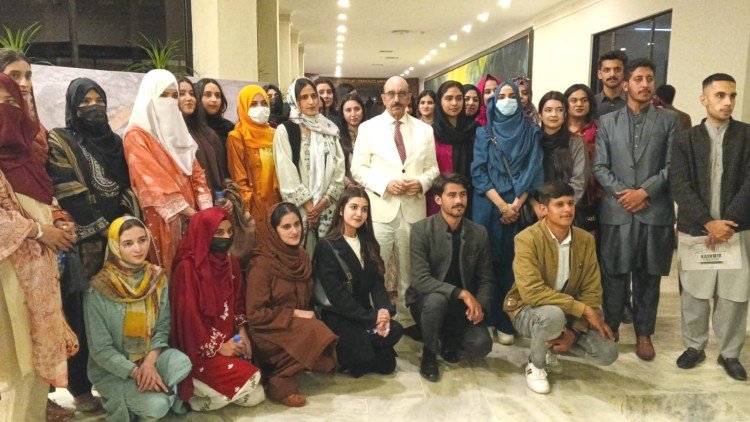
He delivered these remarks while addressing more than 700 students and faculty members at the National Defence University, speaking directly to the youth of Pakistan on the theme “Kashmir at the Crossroads.” The students were from the various universities of Islamabad and Rawalpindi as well as the University of Azad Jammu and Kashmir.
Ambassador Khan emphasized that nations rise through enlightened and educated youth, noting that nearly 160 million young Pakistanis constitute the majority of the country’s 250 million population. He urged students to prepare themselves intellectually, technologically, and morally to shoulder the responsibility of nation-building, stressing that Pakistan’s economic strength, military resilience, and strategic clarity are indispensable for securing justice for Kashmir.
Recalling his decades of advocacy at the United Nations in Geneva and New York, Ambassador Khan said his commitment to Kashmir was driven not by office or position, but by witnessing the suffering of Kashmiri widows and children, the torture of their political leaders, and the illegal detention of thousands in India and IIOJK’s most notorious prisons and detention facilities in Indian-occupied Jammu and Kashmir.
He stated that the freedom struggle of Jammu and Kashmir did not begin in 1947 but dates back nearly two centuries, when Kashmiris resisted Afghan rulers, Dogra dynasty, and later Indian occupation. The people of the Indian occupied Jammu and Kashmir were pushed from one long period of slavery to another era of more brutal despotic, when India occupied the territory on October 27, 1947. He described the present condition in Indian-occupied Kashmir as a continuation of enforced subjugation, marked by killings, heavy militarization, arbitrary detentions, suppression of dissent, communication blackouts, and systematic denial of political rights.
Ambassador Khan said that despite inducements such as infrastructure projects, political appointments, and integration into Indian parliamentary structures, the people of Jammu and Kashmir continue to reject absorption into India. Instead, they persist in demanding the implementation of United Nations Security Council resolutions and the realization of their inalienable right to self-determination under international law and principles of jus naturale. “India has failed to win their hearts and minds”, he said.
He warned that India’s narrative projection and disinformation campaigns seek to normalize the occupation and dilute international awareness of human rights violations, including enforced disappearances, torture, demographic engineering, and collective punishment. He urged Pakistani youth to counter these narratives through credible scholarship, digital engagement, and responsible advocacy.
Referring to last year’s war between India and Pakistan, Ambassador Khan stated that Pakistan successfully defended itself against aggression and prevailed militarily, diplomatically and in the realm of global narratives, with international acknowledgment of the outcome emerging from major world capitals. He stressed that in the modern era, narrative power and technological competence are as critical as conventional military capability.
Calling for national unity and social cohesion, Ambassador Masood Khan urged the youth to embrace emerging technologies, strengthen Pakistan economically and militarily, and commit themselves to making Pakistan one of the world’s leading nations by 2047. He concluded by encouraging students to reject fear and doubt, remain confident in their convictions, and work resolutely to secure freedom and dignity for the people of Jammu and Kashmir.