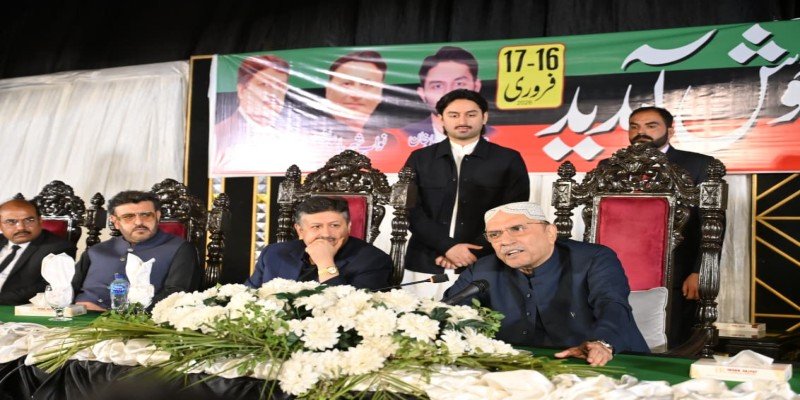
VEHARI : President Asif Ali Zardari declared that agriculture remains the only sustainable solution to Pakistan’s economic challenges, emphasizing that national progress depends upon strengthening farmers, modernizing farming practices, and ensuring water security.
Addressing a public gathering during his visit to Vehari, President Zardari, while reflecting on his previous tenure as President, recalled that when he first assumed office, the condition of wheat production was alarming. He stated that he had urged the then Finance Minister to increase wheat prices to support farmers. When immediate action was deemed difficult, he later exercised his authority to raise the wheat support price, ensuring relief to growers.
He noted that historically, the Government of Sindh has often led the way by announcing wheat prices first, prompting others to follow suit.
President Zardari highlighted that while agricultural inputs in Pakistan are expensive, productivity remains comparatively low. To counter this, he has initiated the production of organic fertilizers on his own farms to reduce dependence on costly chemical inputs. He further revealed that tractors, another major burden on farmers, remain overpriced, but assured that positive developments in this regard would soon be announced.
Underscoring Sindh’s agricultural reforms, he shared that 4,300 miles of canals have been lined and 150,000 acres of land reclaimed, significantly improving irrigation efficiency.
He warned that water will be the cause of future global conflicts, noting ongoing tensions with India over water issues. He stressed that water is not only essential for agriculture but also for public health, cautioning that underground water contamination due to sewage mixing poses a serious threat.
Recalling his earlier role as Environment Minister during the tenure of Benazir Bhutto, he spoke about introducing environmental laws, including mandatory plantation of neem trees due to their health and ecological benefits.
President Zardari reaffirmed that Pakistan is blessed with immense natural resources but lacks policy continuity. He said that during his presidency, he increased salaries of judges and government employees and provided facilities to strengthen institutions, encouraging young lawyers to pursue judicial careers for better justice delivery.
Paying tribute to the foresight of Muhammad Ali Jinnah, he stated that Quaid-e-Azam anticipated the rise of extremist ideologies in India and therefore envisioned a separate homeland for Muslims. He remarked that the Sindh Assembly was the first to vote in favor of Pakistan, followed by Dhaka.
Defending the legacy of Zulfikar Ali Bhutto, President Zardari said the slogan “Idhar Hum, Udhar Tum” was misinterpreted, clarifying that it referred to mutual majority representation and a negotiated political settlement. He added that Bhutto made Pakistan a nuclear power anticipating future regional conflicts, ensuring national security and dignity.
On Kashmir, he reiterated that it remains Pakistan’s jugular vein and vowed that not an inch would be compromised. He strongly criticized the legislative changes by India in the disputed territory.
President Zardari also spoke about preparing the next generation for political leadership, stating that responsible and visionary leadership must continue for Pakistan’s future stability. He appreciated Nawab Shehzad Ali Khan’s initiative to establish a university in Vehari offering free education and suggested naming it after his mother, who donated the land. He further emphasized that a separate section for women should be established, reaffirming that the Pakistan Peoples Party has always prioritized women’s empowerment. He noted that in Sindh, land and housing schemes are being allotted in women’s names to ensure financial independence.
Highlighting modernization, he said he has directed the Sindh government to allocate dedicated budgets for drip irrigation and other advanced agricultural technologies.
Speaking about Karachi’s civic challenges, he acknowledged issues of sanitation, water and infrastructure but assured that significant progress is underway, including the construction of multiple bridges over the Sindh River and ongoing operations against criminal elements.
Concluding his address, President Asif Ali Zardari reaffirmed his unwavering commitment to farmers, national defense, women’s empowerment, environmental protection and institutional strengthening. “Nations are built with continuity of thought,” he declared, adding that lasting progress demands patience, perseverance and a unified national vision.
Later, talking to journalists, President Zardari emphasized that governance requires flexibility and political maturity. He maintained that cooperation in politics prevents extremist approaches from dominating. Praising Prime Minister Shehbaz Sharif, he said efforts are being made to stabilize the country and that meaningful improvement takes time. He criticized the previous government’s tenure, stating that the country had stagnated during those four years.
Speaking on the occasion, Governor Punjab Sardar Saleem Haider expressed gratitude to President Asif Ali Zardari for undertaking a visit to South Punjab, stating that his presence has infused new energy and enthusiasm among party workers.
He said that President Zardari’s arrival has greatly motivated the party’s grassroots supporters and strengthened organizational morale across the region.
The Governor remarked that the manner in which President Zardari has steered the party through challenging times and extended affection and respect to dedicated workers is unparalleled.
Sardar Saleem Haider further stated that political opponents have nothing but propaganda to use against President Zardari, emphasizing that his leadership, political wisdom and crisis management abilities are widely acknowledged.
He added that whenever the country faces difficulties or political uncertainty, President Asif Ali Zardari emerges as the one leader capable of navigating the nation through challenges with experience and composure.