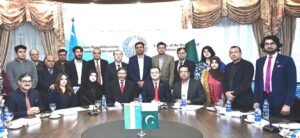
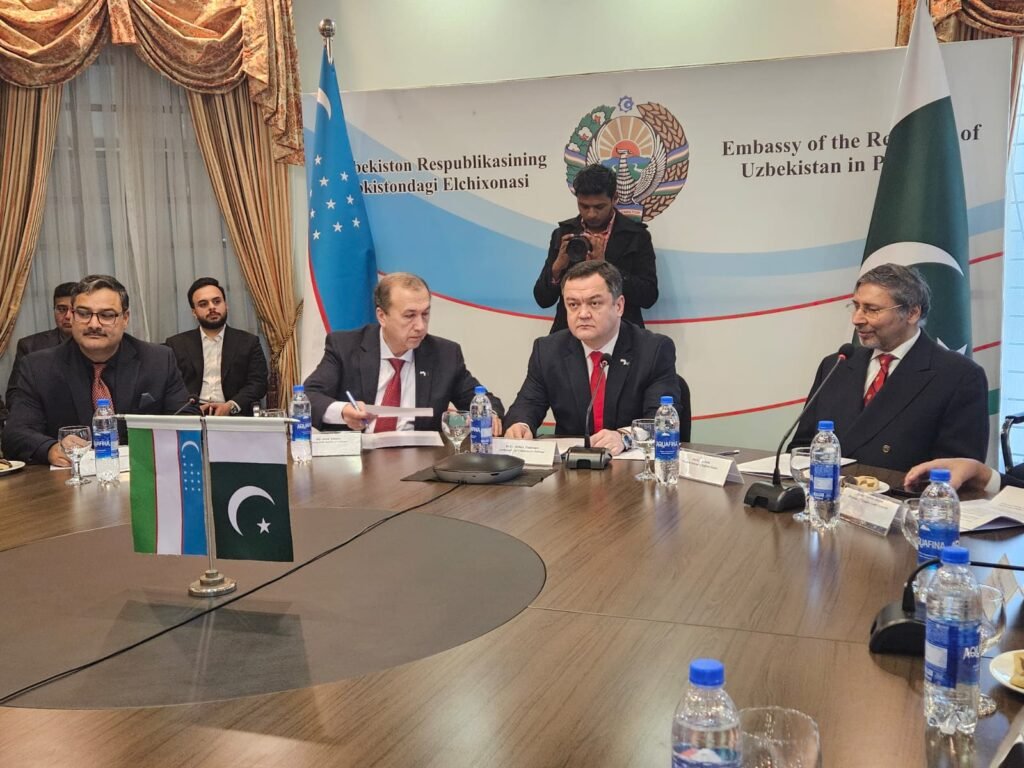
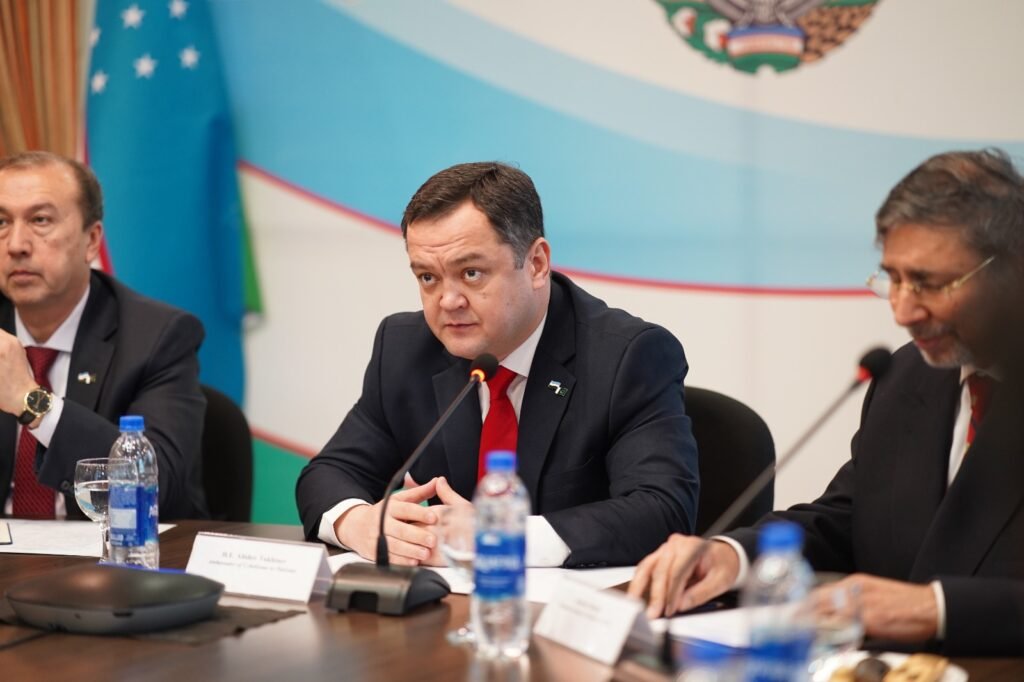
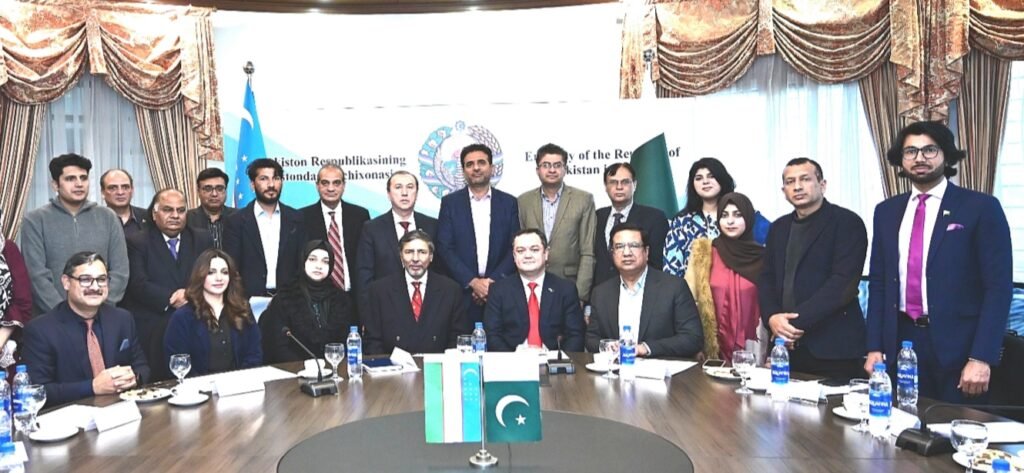
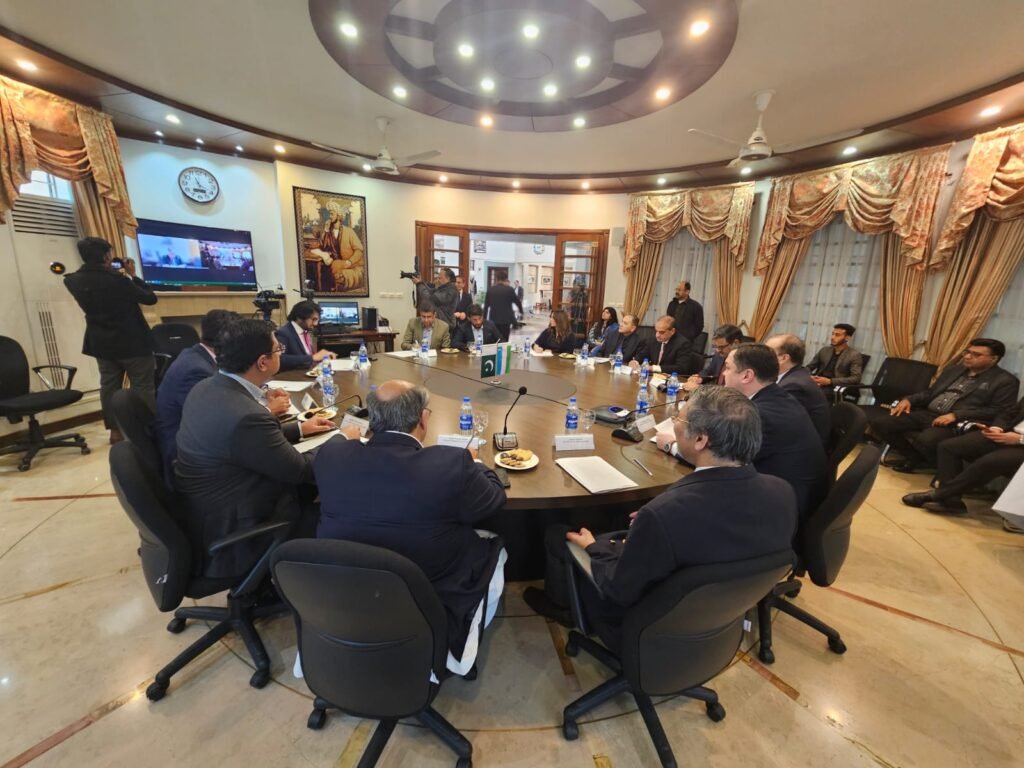
Islamabad : A roundtable took place during the landmark visit of Uzbek President to Pakistan. The session was moderated by Uzbekistan’s Ambassador Alisher Tukhtaev, who warmly welcomed the participants.
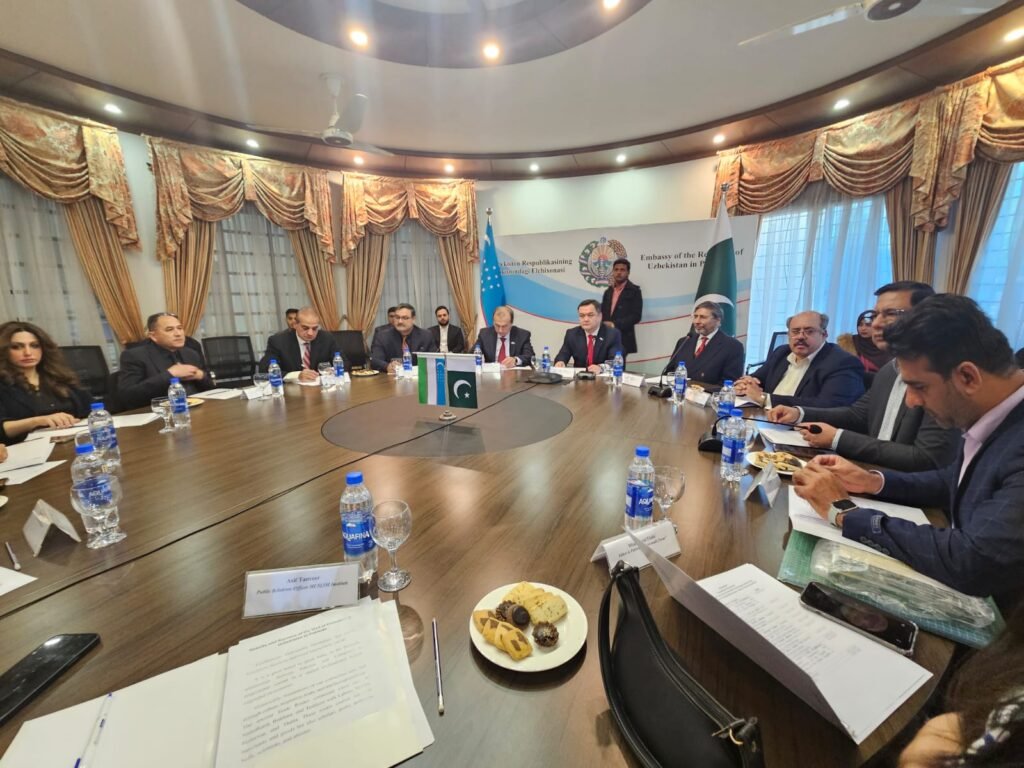
The discussion was steered by Uzbekistan’s Ambassador Alisher Tukhtaev, said that “Uzbekistan and Pakistan on the Path of Strategic Partnership: Outcomes of the State Visit of the President of the Republic of Uzbekistan, His Excellency Shavkat Mirziyoyev, to Islamabad.”
The recent state visit was truly a historic milestone, opening a new chapter in the development of Uzbek–Pakistani relations. It was held in an atmosphere of traditional friendship, mutual respect, and trust that have connected our peoples for centuries. The high-level negotiations reaffirmed the strong political will of both sides to elevate our cooperation to a qualitatively new strategic level.
As a result of the visit, a substantial package of intergovernmental and interagency documents was signed, covering trade, investment, banking and finance, customs administration, industrial cooperation, education, culture, and other areas. These agreements create a solid institutional framework for long-term and systematic engagement.
The economic dimension became a key highlight of the visit. Within the framework of the business forum, an investment portfolio was formed and contracts worth over USD 3.4 billion were signed. The industrial exhibition “Made in Uzbekistan” demonstrated the strong potential of Uzbekistan’s manufacturing sector and concluded with agreements exceeding USD 1 billion.
Particular importance was attached to the development of a joint mechanism aimed at gradually increasing bilateral trade from the current USD 450 million to USD 2 billion over the next five years. This is an ambitious yet realistic goal, supported by concrete instruments and roadmaps.
Of strategic significance for the entire region is the agreement to complete, by 2026, jointly with the Ministry of Railways of Pakistan, the feasibility study for the Trans-Afghan Railway project. Thereafter, the parties intend to proceed with establishing financing mechanisms and commencing practical implementation of this landmark infrastructure initiative, which has the potential to fundamentally transform the transport landscape of Central and South Asia.
During the negotiations, considerable attention was also given to regional security and the sustainable development of Afghanistan. Uzbekistan and Pakistan share a common understanding that Afghanistan must become a bridge of cooperation and connectivity between regions, rather than a source of instability. Economic integration, infrastructure development, and humanitarian assistance are viewed as key instruments in achieving this objective.
The humanitarian dimension of our strategic partnership remains equally important. An agreement was reached to hold a Week of Uzbek Culture in Pakistan, featuring renowned artists, painters, craftsmen, designers, filmmakers, and representatives of the creative community. A symbolic reflection of our shared history and cultural continuity was the announcement of the establishment of a park in Islamabad named after Zahiriddin Muhammad Babur – the great son of the Uzbek people and founder of the Boburid dynasty. Furthermore, it has been proposed to name one of the streets of the Pakistani capital “Tashkent” as a sign of enduring friendship between our nations.
In this context, a significant initiative has been put forward to establish a Joint Cultural Center in Lahore dedicated to the study of Boburid heritage. The Center is envisioned as an effective academic and cultural platform for researching the history of the Mughal era, its architectural monuments, literary and spiritual legacy, as well as for organizing joint conferences, exhibitions, and cultural events. Its activities will deepen cultural dialogue between our countries and foster respect for our shared historical heritage among younger generations.
Special emphasis is also placed on expanding cooperation in education. The launch of the Uzbekistan–Pakistan Working Group on Education will bring bilateral engagement to a systematic and practical level. The Group will coordinate cooperation in higher and vocational education, academic exchange programs, joint research initiatives, and the expansion of mobility for students and faculty members. This initiative will strengthen human capital, encourage the exchange of innovative ideas, and further consolidate our long-term strategic partnership.
Today, we can confidently state that Uzbekistan and Pakistan view each other as strategic partners in shaping a new architecture of regional cooperation. Central and South Asia are gradually emerging as a unified space of opportunity, and our countries serve as natural bridges—geographical, economic, and civilizational.
Ambitious tasks lie ahead: advancing industrial cooperation, expanding energy partnership, driving digital transformation, and strengthening interregional ties. Yet the greatest asset of our cooperation remains mutual trust and the political will to move forward together.
I am confident that today’s roundtable will enable the expert community to further reflect on the outcomes of the visit and formulate practical recommendations for the effective implementation of the agreements reached.
Allow me to express my sincere appreciation to the Pakistani side for its unwavering hospitality and constructive spirit, and to all participants for their active engagement and commitment to the development of Uzbek–Pakistani strategic partnership.
Uzbekistan remains firmly committed to further strengthening cooperation with brotherly Pakistan—for the sake of stability, prosperity, and the well-being of our peoples and the entire region.
Experts and policymakers agree that sustainable peace in Afghanistan is a prerequisite for regional connectivity and economic cooperation. As a geographic crossroads between Central and South Asia, Afghanistan’s stability will determine whether the broader vision of integrated regional trade and prosperity can be fully realized.
Report By Sohail Majeed Butt