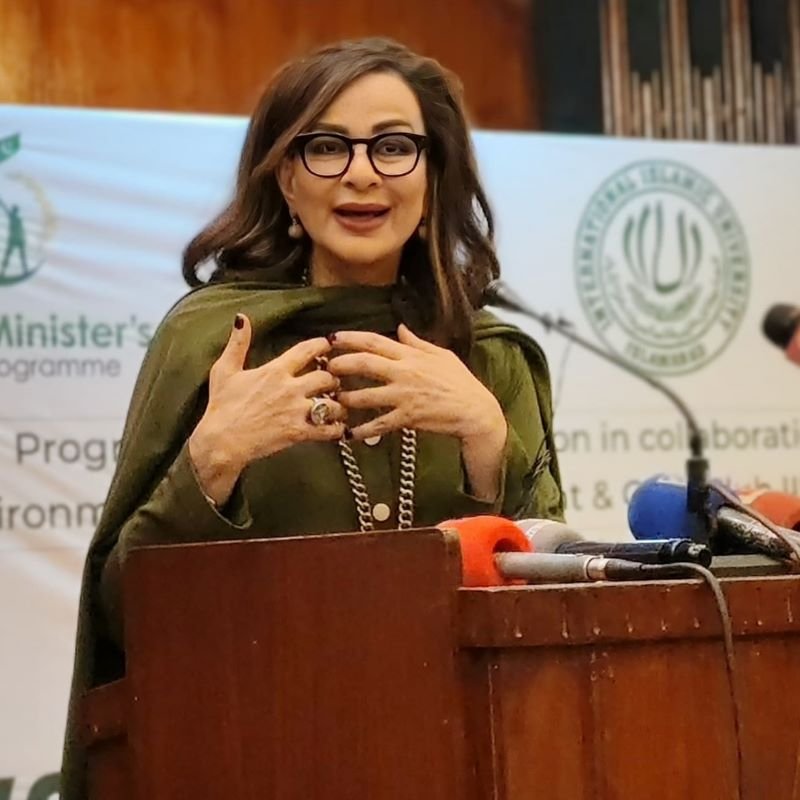
Karachi:— Senator Sherry Rehman delivered a wide-ranging and powerful keynote address at the inauguration of the 17th Karachi Literature Festival (KLF), situating Pakistan’s present moment within an increasingly volatile global landscape.
Quoting Chairman Mao’s famous line, “Everything under heaven is in utter chaos; the situation is excellent,” she stressed that moments of disruption often set the stage for realignment, and the ability to define and understand challenges is the first step towards navigating them.
Placing this within a global context, Senator Rehman said that Pakistan has emerged into an era defined by escalating conflict, weakened multilateral systems, climate emergencies and AI-driven disruptions. “Global frameworks for peace, security and rights have gone south,” she said. “We are living through one of the most perilous moments since the Second World War—yet this is precisely the time in which we must train ourselves to find opportunities and hope.”
In her address, she described how Pakistan’s neighbourhood remains deeply unsettled. The western border with Afghanistan, she noted, has grown increasingly hostile due to militant outfits operating with impunity. Senator Rehman warned that Pakistan cannot afford to become desensitised to terror or conflict, recalling how the insurgency of 2008 began with attacks on girls’ schools in KP before metastasising into one of the world’s most lethal waves of violence. She observed that the global arena itself has become “nasty, brutish and short”, with more active conflicts today than at any time since the Second World War. The militarisation of technology, particularly AI, has added additional layers of unpredictability on the battlefield.
Reflecting on the limited conflict of May 2025, she said Pakistan “performed spectacularly” but stressed that no country should ever celebrate war because it represents the opposite of development, growth and human security.
On relations with India, Senator Rehman reiterated Pakistan’s willingness to pursue peace and dialogue, but cautioned that the Modi government has kept the region trapped in a “new abnormal”, weaponising water, and even weaponising cricket. “Pakistan cannot simply roll over and ask for the other cheek to be slapped,” she said. Energy supply chains, tariff wars, and climate shocks now dictate national decisions, and while China remains Pakistan’s anchor ally, the country must still navigate complex alignments with major powers. “Foreign policy requires you to bite the bullet,” she added, noting that Pakistan must learn to manage external shocks with strategic foresight.
Senator Rehman presented a series of stark indicators that reflect Pakistan’s developmental and economic realities, she noted that the country today carries over PKR 80 trillion in public debt, pays PKR 8.2 trillion annually in debt servicing, and is left with only PKR 4 trillion for development spending out of a total of PKR 17 trillion. At the same time, 26 million Pakistani children remain out of school, 40% of children under five are stunted, and 72% of Pakistani women continue to shoulder the burden of carrying water despite their participation in the labour force standing at just 22%.
Senator Rehman pointed out that unemployment has now crossed 7%, while three million young people enter the job market each year with few opportunities created in the manufacturing and industrial sectors that could absorb them. With Pakistan’s population now at 241.5 million as reported by UNFPA and growing at 2.55%, one of the highest rates in Asia, she said that Pakistan’s demographic pressures cannot be addressed without a serious public conversation on jobs, growth, and economic restructuring.
Senator Rehman said “Our economy has stabilised on paper—yet the lived experience of people has not changed,” she said. She warned that shutting down loss-making state-owned enterprises without stimulating the industrial or manufacturing sectors that create jobs is not a plan. “Where exactly will the jobs come from? The service sector cannot absorb everyone, and agriculture cannot carry this burden alone,” she said, adding that Pakistan continues to tax and super-tax the same businesses, driving many out of the country while millions of skilled young people leave for work abroad. She repeated what she told the Senate Finance Committee earlier this week—that Pakistan urgently needs a national conversation on job creation, youth opportunities, and industrial strategy.
She also reminded the audience that Pakistan remains on the climate frontline, yet receives nearly 80% of its climate finance in the form of loans, even as the world spends USD 6.6 trillion on military build-ups and USD 7 trillion subsidising fossil fuels, leaving developing economies in prolonged cycles of vulnerability.
Turning to the climate polycrisis, Senator Rehman said that environmental breakdown has become a new battlefield. Pakistan, home to the largest number of glaciers outside the polar regions, is on the frontline of cascading climate shifts. She described plastics as a “forever chemical” that takes more than a thousand years to decompose, with only 9% recycled globally and just 1% in Pakistan—adding significantly to environmental disorder. She said that when a mega flood hits Jamshoro or Texas, there is very little that human beings can do to stop its surge. South Asia, she warned, is caught in a deepening water–climate–agriculture crisis, where the poorest and most vulnerable are always hit first and hardest.
Senator Rehman added Pakistan must push for a global debt reset because the Bretton Woods system is no longer functioning for developing countries. She noted that the SDGs are slipping, the UN has lost much of its agency, climate financing is not flowing at scale, and Pakistan cannot wait for the world to fix a system that is failing. “Your house is burning. Do not wait for anyone—no one is coming,” she said. “We must build our own story, our own narrative, our own local solutions.”
Reflecting on the significance of the Karachi Literature Festival itself, she added that while global elites travel to Davos, governments convene at the UN General Assembly, and climate actors gather at COPs, Pakistan throngs to its literature festivals. “These festivals have a real gravitational pull,” she said. “They are rooted in authenticity, storytelling and truth. They build community. They build hope. And in times of chaos and disorder, that matters.”