
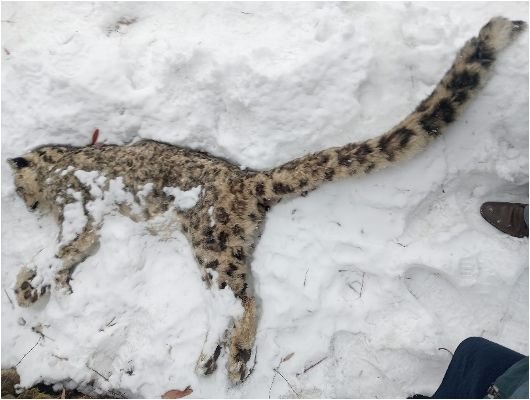
Chitral :- Snow Leopard’s Natural death in the Garam Chashma area of Chitral has been confirmed following a joint field assessment and postmortem examination by the Khyber Pakhtunkhwa Wildlife Department and the Snow Leopard Foundation (SLF). Authorities and conservation experts say the incident reflects improving coexistence between communities and snow leopards, supported by active protection and conflict-mitigation measures.
The carcass of a male snow leopard was discovered on 19 January, in a forested area above Wakht village in Garam Chashma. A postmortem conducted by an experienced veterinarian concluded that the animal—approximately 12 years old—died due to severe diarrhea and dehydration linked to old age and prolonged food shortage. There was no evidence of poaching, poisoning, snaring, or any form of human-induced harm.
A rare but meaningful signal
In many parts of the world, large carnivores are killed by humans before reaching old age. Against this global backdrop, experts say that a snow leopard dying naturally is a rare ecological signal—indicating that the animal successfully survived the most dangerous phases of its life in a human-dominated landscape.
Dr. Shezra Mansab Kharal, Minister of State for Climate Change and Environmental Coordination, said the incident highlights the value of science-based conservation and community engagement:
“This case demonstrates that when communities are supported, informed, and engaged, coexistence with iconic species like the snow leopard is possible. A natural death of such a rare animal reflects improved protection, responsible governance, and growing public awareness in Pakistan’s mountain landscapes.”
Community response and rapid mitigation
The Garam Chashma area had come into focus in recent months after videos of snow leopards moving near villages went viral, causing fear among residents. In response, the KP Wildlife Department and SLF conducted community awareness meetings, reassured residents, and promoted preventive livestock-protection measures.
Rather than demanding compensation after livestock losses, local communities requested long-term, sustainable solutions. SLF responded promptly by providing livestock vaccination, and committed to extending other conflict-mitigation measures already operating elsewhere in Chitral, including predator-proof corrals, livestock insurance schemes, and conservation education.
Mr. Jamal Leghari, GSLEP Emissary, emphasized the broader regional significance:
“Across the snow leopard range, most individuals are lost to human-related causes. When a snow leopard survives long enough to die naturally, it tells a powerful story—that coexistence is working on the ground. Chitral is showing how community-based solutions can change outcomes for people and wildlife alike.”
Active protection on the ground
The KP Wildlife Department confirmed that the response to the incident was immediate and transparent.
Farooq Nabi, Divisional Forest Officer (Wildlife) Chitral, of KP Wildlife Department , stated:
“Our field teams inspected the site thoroughly and found no signs of conflict or illegal activity. The postmortem clearly indicates natural causes. This outcome reflects consistent patrolling, community cooperation, and our close coordination with partners like the Snow Leopard Foundation.”
Conservation perspective
Dr. Muhammad Ali Nawaz, Director of SLF, noted that the incident should be viewed in a broader conservation context:
“In landscapes where human-caused mortality usually dominates, a natural death is not just a biological event—it is a coexistence signal. It shows that this snow leopard avoided persecution and conflict throughout its life. The trust built through livestock vaccination, insurance, predator-proof corrals, and conservation education is clearly making a difference.”
He added that while the loss of any snow leopard is tragic, the circumstances of this case demonstrate that preventive, community-centered conservation works.
Looking ahead
Authorities and SLF reaffirmed their commitment to:
- Strengthening community-based conflict mitigation
- Expanding livestock insurance and predator-proof infrastructure
- Continuing awareness and education programs
- Maintaining strong protection and monitoring across Chitral’s snow leopard habitat
As Pakistan continues to advance its commitments under CBD’s Global Bioldiversity Framework global biodiversity and GSLEP, the Garam Chashma case stands as an example of how coexistence, not conflict, can define the future of human–wildlife relations in mountain landscapes.