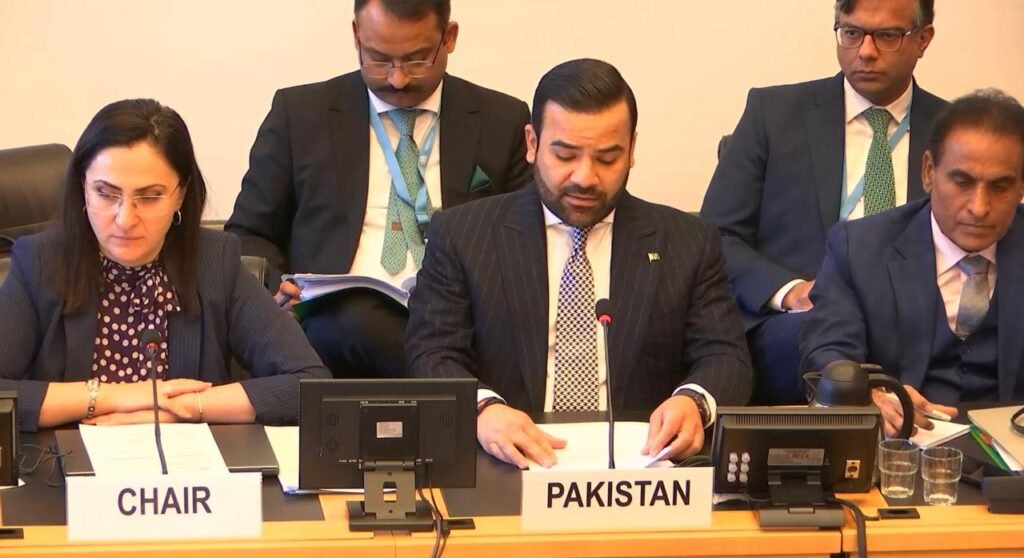
Stakeholders attend live screening of Pakistan’s interactive dialogue with UNCRC
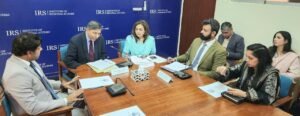
ISLAMABAD : National Commission for Human Rights (NCHR), Justice Project Pakistan (JPP), Group Development Pakistan, Parliamentarians Commission for Human Rights (PCHR) and the Legal Aid and Justice Authority (LAJA) collaborated to host live screening session of Pakistan’s interactive dialogue with the UN Committee on the Rights of the Child.
Organised with the support of European Union, the session was live screened in the presence of prominent civil society activists, diplomats, lawyers, child rights advocates, academics, policy practitioners and legal aid stakeholders engaged in children’s rights, criminal justice reform, and human rights accountability. By bringing together diverse stakeholders, the screening was aimed at fostering informed discussion, encourage cross-sector collaboration, and strengthen national engagement with the CRC review process.
The United Nations Convention on the Rights of the Child (CRC) is the most widely ratified international human rights treaty, setting out a comprehensive framework for the protection and promotion of the civil, political, economic, social, and cultural rights of children. Pakistan ratified the CRC in 1990 (becoming the fifth country to do so) and is therefore obliged to align its laws, policies, and practices with the Convention’s standards. Under Article 44 of the CRC, States Parties are required to submit periodic reports to the UN Committee on the Rights of the Child, an independent expert body mandated to assess compliance, engage in constructive dialogue with governments, and issue Concluding Observations containing recommendations for reform.
In August 2023, Pakistan submitted its combined sixth and seventh periodic reports, covering the period from June 2016 to June 2021. Pakistan’s review before the Committee constitutes a critical moment, particularly given the country’s large child population and the persistent structural challenges affecting children’s rights across multiple sectors, including juvenile justice, education, health, protection from violence, and access to legal safeguards. In light of Pakistan’s international commitments, including under the EU GSP+ regime, meaningful implementation of the CRC remains central to advancing the rule of law, social inclusion, and equitable outcomes for children.
National Commission for Human Rights (NCHR) submitted an independent alternative report to the UN Committee on the Rights of the Child, highlighting key gaps in Pakistan’s protection of child rights. The submission addresses issues such as early-age marriage, child labour, juvenile justice and barriers to basic services. As an “A”-status NHRI, NCHR’s independent evidence strengthens international accountability and supports better, rights-based reforms for children in Pakistan.
NCHR advances children’s rights through sustained legal and policy advocacy, judicial intervention, research and public engagement across all provinces. Its work has led to legislative inputs on child marriage, child labour, education and juvenile justice alongside suo motu action in cases of sexual violence, police abuse and unlawful detention of children. Via prison monitoring and litigation support, NCHR has facilitated the release or acquittal of over 200 juveniles and conducted extensive jail visits nationwide to assess compliance with the Juvenile Justice System Act 2018.
The two-day review began with the first session of Pakistan’s interactive dialogue with the Committee. During that session, Committee members raised a number of important and pointed questions to the State. These included questions on whether budget allocations for children are child-friendly and adequately prioritised; how Pakistan is ensuring appropriate alternative care for children without parental support; and how effectively the prohibition on the death penalty for children is being implemented in practice. The Committee also asked about access to free legal aid for children in conflict with the law, the use of age-determination procedures. Led by Minister of State for Law, Justice and Human Rights Barrister Aqeel Malik, the Pakistan’s delegation presented the progress it has made in realizing child rights before the UN Committee of 18 independent experts and answered the questions raised by the Committee members.
Minister of State for Law, Justice and Human Rights Barrister Aqeel explained that Pakistan’s legal framework recognises children as independent rights holders with statutes such as the Juvenile Justice System Act 2018 redirecting state responses away from retribution and towards rehabilitation, diversion and social reintegration. He noted that the Juvenile Justice System Act establishes a clear legal separation between children in conflict with the law and adult offenders.
He highlighted the Zainab Alert, Response and Recovery Act 2020 as a key reform that has improved institutional coordination and rapid response in cases of child abduction, abuse and sexual exploitation. He also states that bodies such as Child Protection Authorities, Juvenile Justice Committees and Zainab Alert Cells reflect a system based on permanent institutional arrangements rather than temporary or improvised interventions. He recalled that Article 25 A of the Constitution guarantees free and compulsory education for children between five and sixteen years of age, affirming education as an enforceable constitutional right.
Secretary for Federal Ministry of Human Rights Abdul Khalique Sheikh stated that Pakistan has taken firm legislative and policy steps to safeguard children from online abuse, harassment and cybercrimes through coordinated work with civil society and National Commission on the Rights of Children. He said that recent criminal law amendments have strengthened penalties for crimes against children with specific focus on cyber related violations.
Delegate Sarah Ahmed, MPA and Chairperson Child Protection Welfare Bureau, highlighted Pakistan’s progress on polio eradication, noting improved access, reduced security constraints, and expanded vaccination efforts, while acknowledging persistent challenges in parts of southern KP. Addressing maternal and child health, Sarah Ahmad emphasized Pakistan’s rights-based reproductive health framework, constitutional protections, and national policies aimed at improving access to healthcare for women and girls.
Delegate Barrister Haya Zahid, CEO Legal Aid Society, said that that education is a national emergency, backed by an out-of-school children fund of PKR 25 billion, with plans to scale further. “Girls’ dropout is not just a schooling issue — it’s a whole-of-system social protection challenge,” she said.
Advisor to Prime Minister Barrister Zafarullah Khan At the CRC Review, Zafar Ullah Khan, Advisor to the Prime Minister, highlighted Pakistan’s Changing Diabetes in Children programme, with 27 specialized clinics providing free insulin and supplies, and a target to support 6,000 children by 2030. He emphasized that the law obligates the state to establish protection centers, safe houses, and complaint mechanisms, including access to NCHR and other commissions without requiring legal representation.
Delegate Aziz Sohail from Ministry of Human Rights highlighted Pakistan’s constitutional guarantee to a clean, healthy, and sustainable environment under Article 9A, emphasizing protection of children and women from climate change impacts. Aziz Sohail noted federal efforts to strengthen disaster management authorities, and highlighted child-centered interventions in disasters.
The presentation by delegates was followed by question by the UN Committee members. The sessions ended with answers and concluding comments from Pakistan’s delegation.