ISLAMABAD : Acting President Syed Yousaf Raza Gilani described education diplomacy as one of the most enduring instruments of international engagement amid stressing sustained academic partnerships beneficial for the country to address deep-rooted challenges in its education sector and prepare its youth for a rapidly changing world.
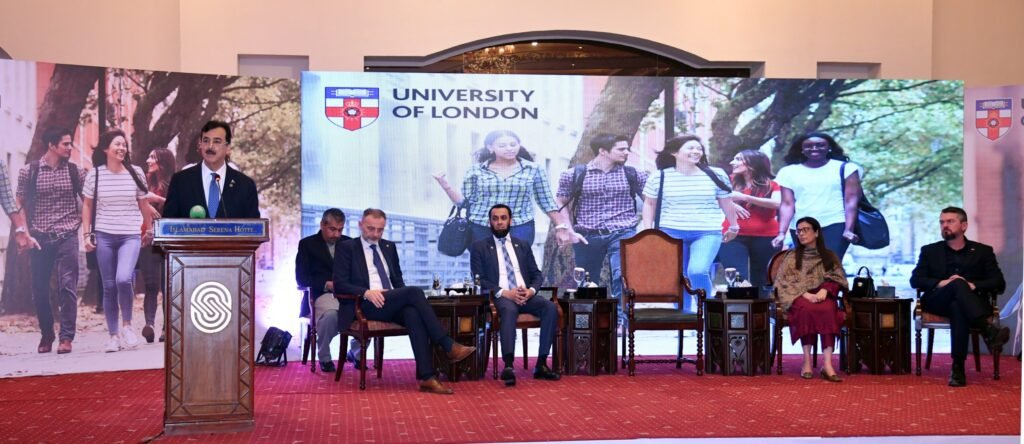
Addressing a reception hosted in honour of a visiting delegation of the University of London and its alumnus, the acting president Gillani said the presence of the delegation symbolised a bridge of knowledge, aspiration and partnership between Pakistan and the United Kingdom. He paid tribute to the University of London’s global standing and its nearly two centuries of contribution to human progress across disciplines.
Acting President Gilani noted that many distinguished Pakistanis were alumni of the University of London and had gone on to excel in public service, law, medicine, academia, business and diplomacy. This shared academic heritage, he said, formed the bedrock of bilateral educational cooperation and provided a strong basis for expanding ties.
He said the University’s international programmes and recognised teaching centres had enabled thousands of Pakistani students to access world-class education without leaving the country. “This had helped democratise learning and allowed young Pakistanis to compete globally while remaining rooted at home,” he added.
The acting president underlined that the country stood at a critical juncture in its educational development. Despite the resolve of its people and educators, he said the sector continued to face structural problems, including a large number of out-of-school children, gender disparities and regional inequalities that disproportionately affected girls and rural areas.
In response, he recalled, the government had declared a national education emergency in 2024 to ensure equitable access to schooling and improve learning outcomes through coordinated federal and provincial efforts.
He referred to the National Education Policy Development Framework 2024 as a comprehensive roadmap for reform, and cited initiatives such as the Benazir Taleemi Wazaif programme, which provided conditional support to encourage school participation. He also pointed to the impact of climate-related disasters, including the 2022 floods, which had damaged educational infrastructure and underscored the need for resilient and adaptive education systems.
Acting President Gilani said education had remained a central national priority during his tenure in various constitutional roles, including as prime minister and speaker of the National Assembly. The establishment of new institutions, such as the University of Swat, he said, reflected the belief that education was the most effective response to conflict, extremism and underdevelopment.
As chairman of the Senate since 2024 and currently acting president, Gilani said he remained convinced that investment in education was not a cost but the foundation of national progress. He added that the Senate had consistently used its legislative and oversight role to advocate sustained funding and reforms in the education sector.
He highlighted that education at present transcended national boundaries, particularly in an era shaped by rapid technological change, climate challenges and the rise of artificial intelligence. He noted that Pakistan’s approval of the AI Policy 2025 and the Digital Sector Roadmap 2025–2035 reflected its commitment to preparing youth for the digital economy, with IT exports reaching $3.8 billion and growing at around 20 per cent annually.
He stressed that technology alone was insufficient, and called for deeper partnerships with institutions such as the University of London to build capacity, enhance pedagogy, and inspire excellence. He expressed confidence that the visit of the delegation would open new avenues of collaboration, benefiting students in particular, whom he described as the country’s future.
Earlier, Federal Minister for Information and Broadcasting Attaullah Tarar commended the University of London for its long association with Pakistan and for introducing Pakistan-focused modules in its law programmes. Sharing his experience as an alumnus, he said the education he received had strengthened his professional capabilities and public service.
In his welcome note, Pro Vice-Chancellor of the University of London, Professor Phil Allmendinger said the institution viewed its engagement with Pakistan as part of a forward-looking approach to shaping the future through education. He highlighted the strength of the university’s alumni network in Pakistan, noting that 25 alumni ambassadors were contributing to public policy and governance.
Professor Allmendinger announced that a University of London delegation would visit Lahore, Islamabad and Karachi this year to engage with students and alumni, and meet government representatives. He also announced a special scholarship initiative for Pakistan, including three full-time scholarships, adding that more than 40 Pakistani students worldwide would benefit from University of London scholarships this year.
Head of the British Council in Pakistan, James Hampson said education was a vital pillar of Pakistan-UK relations and described the University of London as the largest distance-learning institution in the UK. He noted that thousands of Pakistanis educated in the UK were now serving in influential positions across the country, strengthening people-to-people ties.
Justice Ayesha A. Malik of the Supreme Court said membership of a prestigious alumni community carried responsibilities alongside privilege. She emphasised that access to quality education was a fundamental right and urged graduates of leading institutions to contribute to institution-building and uphold standards, particularly for those without similar opportunities.
MNA Ali Muhammad Khan, also an alumnus, said the university had instilled strong research skills in its students and called for expanded scholarship support to ensure that quality education was accessible to lower- and middle-income groups.