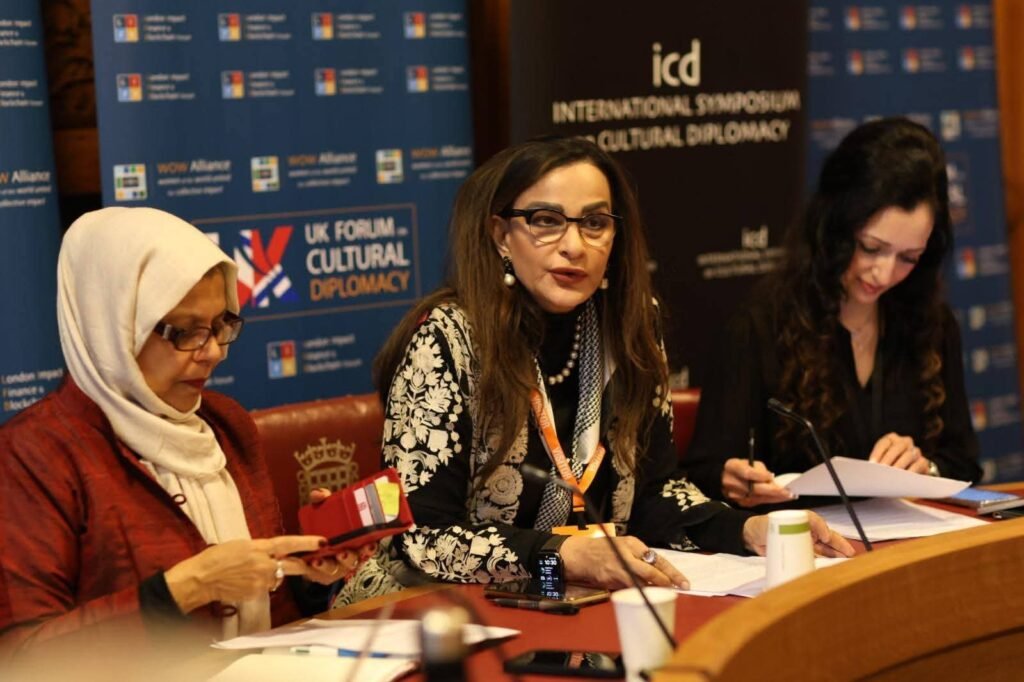
London —: UK Forum on Cultural Diplomacy held at the House of Lords, Senator Sherry Rehman — Vice President Pakistan Peoples Party (PPP) and Chairperson of the Senate Standing Committee on Climate Change — delivered a powerful keynote on “Women in Politics” urging global political systems to “move beyond celebration to real structural change”.
To her, women in politics represent three intertwined imperatives: to assess where we stand, to understand what women need from politics, and to shape collective agendas that transform societies.
Drawing on global statistics, she noted the sobering realities of political representation: women hold only 27.2% of parliamentary seats worldwide, and just 29 countries have women as Heads of State or Government. At current trends, she warned, gender parity in political leadership is over 130 years away,(UN, 2025), describing this gap as “a stark indictment of the systems that shape public life.”
Yet Senator Rehman reminded the audience that women in politics transform the spaces they enter. “When women lead,” she said, “they ask different questions, set new priorities, and model collaborative, inclusive, and people-centric governance.
During COVID-19, countries led by women locked down faster, communicated with clarity, and ultimately suffered half the deaths on average compared to male-led nations.”
Senator Rehman spoke about the political leadership of Shaheed Mohtarma Benazir Bhutto, calling her “an iconic leader who blazed a trail for generations of women” when she became the first woman elected Prime Minister of any Muslim-majority country. “At Beijing in 1995, Benazir Bhutto signed on to a transformational platform for women’s rights,” she said. “Thirty years later, we must ask why women are still defending gains we thought were secure.”
She warned that as conflicts multiply and multilateralism weakens, rights protections are eroding across continents. “Rights and SDGs are no longer the global priority the world imagined for the 21st century.”
Turning to Pakistan, Senator Rehman underscored both the challenges and leadership of women in parliament. Despite making up just 17% of Pakistan’s legislature, women parliamentarians contributed nearly 50% of all parliamentary business last year, a statistic she described as “reflective of the invisible care economy women run everywhere, and the extra labour they shoulder in public spaces too.”
She outlined her legislative journey since 2002, she moved five key bills protecting and empowering women, including legislation mandating women’s political participation in parties. These included the Harassment at the Workplace Act, the Child Marriage Restraint legislation (which took 9 years), and the Domestic Violence law (achieved after 21 years of advocacy). “The lesson,” she said, “is that women pass the baton across generations. Coalition-building is our political muscle.”
Senator Rehman also showcased Pakistan’s gender-sensitive social protection achievements: through the Benazir Income Support Programme (BISP), cash transfers directly to women’s bank accounts empower them within their families, reshape decision-making at home, and strengthen their role in communities. Over 2 million women now exercise ownership in climate-resilient housing programs, altering local power dynamics in Pakistan’s flood-hit regions.
Despite overall gains, she noted the disturbing rise in abuse against women lawmakers globally. “Across five regions, 82% of women parliamentarians experience harassment, including threats, mobbing, and digital violence. Around 44% face online death or assault threats. My concern is for the young women inheriting this digital hostility.”
Senator Rehman concluded with a call for sustained alliances:
“There is no silver bullet for dismantling structural exclusion and misogyny. But when women’s voices are stifled, we must insist on being heard. Change comes at a cost — and we are prepared to pay it with political stamina and solidarity. Our sisters, and many of our brothers, stand with us. That solidarity is our greatest strength.”