
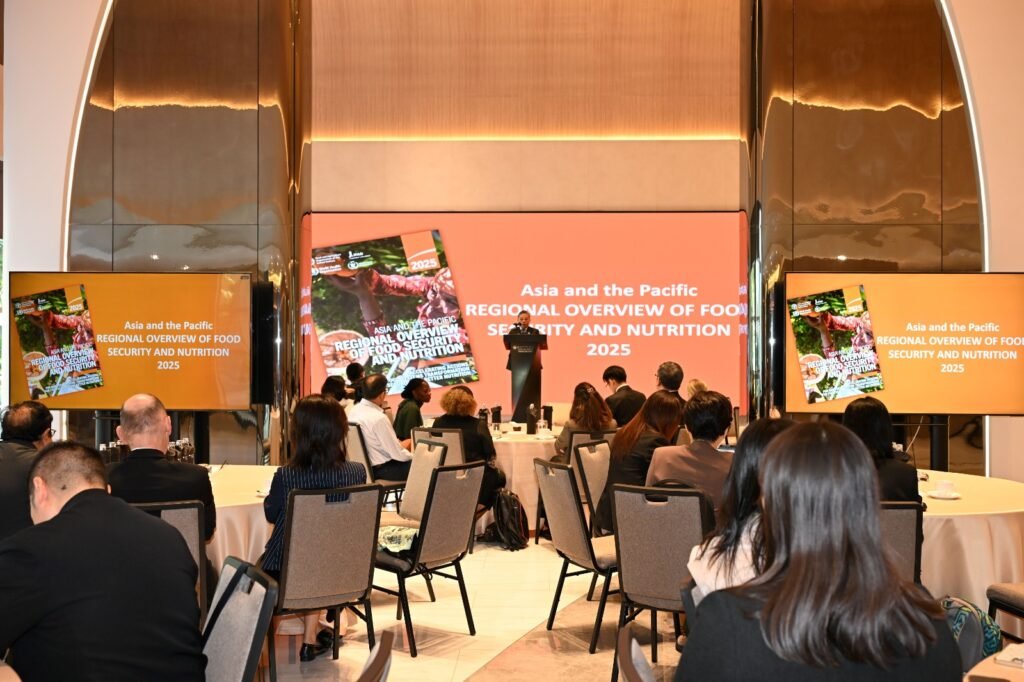
Bangkok —: State of Food Security and Nutrition in Asia and the Pacific flagship report, jointly released by the Food and Agriculture Organization of the United Nations (FAO), the International Fund for Agricultural Development (IFAD), the United Nations Environment Programme (UNEP), the United Nations World Food Programme (WFP), and the World Health Organization (WHO), shows that while the region has made notable progress in reducing hunger, persistent challenges remain in addressing malnutrition, food insecurity, and unequal access to healthy diets.
According to the report, the prevalence of undernourishment in the region declined to 6.4 percent in 2024, down from 7.0 percent in 2023, marking a significant improvement. This progress translates into 25 million people escaping hunger in just one year.
Despite these gains, the report cautions that progress is uneven, with nearly 80 percent of people living in South Asia facing hunger, where moderate or severe food insecurity remains the highest among all subregions.
Overall, Asia and the Pacific region still account for nearly 40 percent of the world’s hungry, underscoring the region’s critical role in achieving global food security and nutrition goals.
The double burden of malnutrition
The report underscores that hunger is only one dimension of the region’s nutrition challenge. In 2024, almost a quarter – 24.4 percent of children under five were stunted, with South Asia recording the highest prevalence at 31.4 percent. Child wasting also remains alarmingly high at 8.9 percent, exceeding the global average, and reaching 13.6 percent in South Asia.
The region is experiencing a double burden of malnutrition. Adult obesity continues to rise, particularly in Oceania, while anaemia affects 33.8 percent of women aged 15–49 years, representing a severe public health concern with long-term consequences for maternal and child health, productivity, and economic development.
Healthy diets remain out of reach for millions
The report finds that the cost of a healthy diet in Asia and the Pacific averaged USD 4.77 per person per day on Purchasing Power Parity (PPP) basis in 2024, which is higher than the global average. Although the proportion of people unable to afford a healthy diet has declined, affordability remains a major barrier. South Asia continues to face the greatest challenge, with 41.7 percent of its population unable to afford nutritious food.
Call for transformative action
Under the 2025 report theme, “Accelerating actions for agrifood systems transformation for food security and better nutrition,” the analysis examines regional progress toward key 2030 Sustainable Development Goal (SDG) indicators, particularly SDG 2: Zero Hunger, as well as select World Health Assembly global nutrition targets.
The flagship report stresses that the agrifood systems in the region are at a critical juncture: despite decades of strong economic growth and significant poverty reduction, far too many people continue to experience undernourishment, micronutrient deficiencies, and the harmful health impacts of overweight and obesity.
The report therefore calls for accelerated and transformative agrifood systems transformation to address the root causes of food insecurity and malnutrition in all its forms, align food supply with dietary needs, improve access to affordable, diverse, safe, and nutritious foods, and promote positive dietary behaviour change across the region.
The urgency of this transformation was reaffirmed at the United Nations Food Systems Summit +4 (UNFSS+4) in Addis Ababa, where governments and stakeholders renewed their commitment to reshaping food systems as a critical pathway to achieving the SDGs by 2030.
Key recommendations
To sustain progress and close remaining gaps, the report highlights four priority actions:
Strengthen multisectoral governance and inclusive policies that address food security, nutrition, health, climate, and social protection.
Mobilize sustainable finance to scale up high-impact interventions and innovations across agrifood systems.
Empower marginalized populations, including women, youth, and Indigenous Peoples, as agents of change.
Promote climate-smart and sustainable agricultural practices to build resilience and protect natural resources.
The report calls for unprecedented collaboration across sectors, stakeholders, and scales to redesign agrifood systems that can feed and nourish all people, sustain the planet’s natural bounty, and unlock equitable prosperity.
Together, the UN agencies are intensifying efforts with member countries to reshape and reimagine food systems across Asia and the Pacific region to make them more efficient, inclusive, resilient and sustainable, leaving no one behind.
The full 2025 State of Food Security and Nutrition in Asia and the Pacific 2025 report is available here.