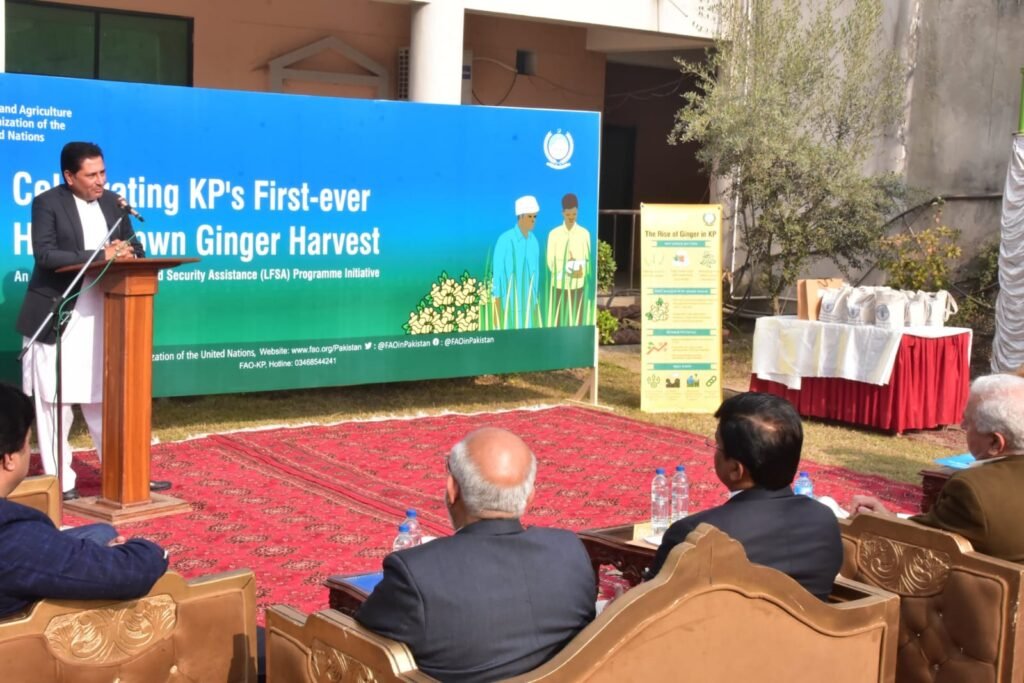
Peshawar — Khyber District has marked a historic milestone today: the successful harvest of high-quality ginger grown locally for the first time. A crop Pakistan has always imported is now being produced by farmers in KP — opening the door to a new billion-rupee opportunity for the region.
The harvest was celebrated in Peshawar in the presence of FAO’s Acting Representative in Pakistan, senior officials from the KP Agriculture Department, researchers from ARS KP and NARC Islamabad, district authorities, community leaders, and farmers.
The success of the pilot did not happen by chance — it was the result of several important factors coming together at the right time. Farmers received good-quality seed from a trusted private-sector partner, and FAO trained them through its Farmer Field School approach, giving them the skills to handle a completely new crop. Throughout the season, FAO, ARS, and Agriculture Extension teams provided continuous technical guidance, while farmers themselves showed strong motivation and ownership. The natural conditions in Bara — favourable climate and soil — further supported the crop’s performance, and the relatively low entry cost made ginger an attractive option for smallholders. The private sector remained actively engaged throughout, creating opportunities for learning and future market linkages.
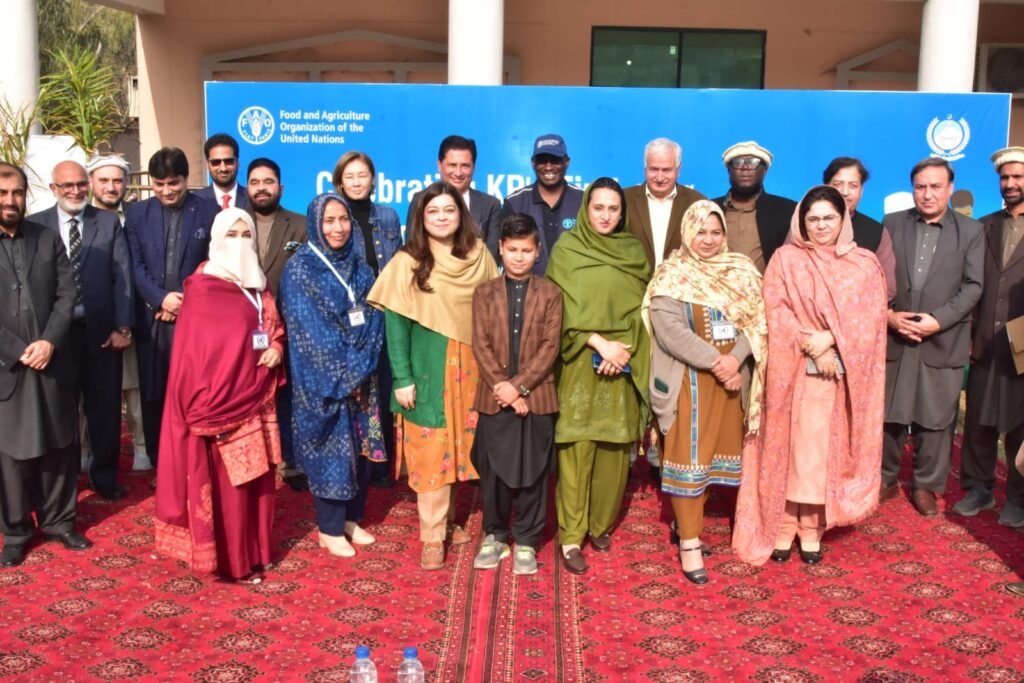
When all these dots connect — seed, skills, support, climate, and private-sector engagement — a value chain begins to take shape. Ginger is now proving exactly that in KP.
Speaking at the event, James Okoth, FAO’s Acting Representative in Pakistan, said:
“This pilot shows what becomes possible when everyone works together — farmers, researchers, extension teams, and the private sector. When farmers get good seed, adequate training, and timely guidance, and when the environment supports it, a new crop can really take off. Ginger is now showing great promise for Khyber and beyond.”
FAO guided farmers step by step through the entire season, helping them prepare, plant, and manage the crop. Exposure visits to Punjab gave them the reassurance that they, too, could succeed.
A farmer shared: “We had never grown ginger before. FAO supported us from day one and stayed with us throughout the season. Now the crop has succeeded, and we are confident to expand and even share seed with other farmers. This is a game changer for us.”
A High-Value Opportunity for Pakistan
Pakistan imported USD 42.7 million worth of ginger in 2023. With successful yields now demonstrated in KP:
Farmers can earn far more compared to traditional crops the country can reduce its reliance on costly imports
new value chains and rural employment — especially for women and youth — can emerge.
Ginger also shows strong potential for value addition, including dry ginger, powder, pastes, and seed multiplication.
Scaling Up Across KP
Encouraged by the pilot’s success, the KP Agriculture Department and FAO are planning to expand ginger cultivation to three additional merged districts. Continued collaboration with ARS KP, NARC, Agriculture Extension, and private-sector actors will guide the next phase. There is also potential for related high-value crops like turmeric, and for establishing local seed systems and community-level processing units.
A New Chapter for Farmers in Khyber
This successful pilot has shown that with the right support, Khyber District can grow high-value, climate-resilient crops that raise incomes and strengthen rural livelihoods.
Ginger is no longer just an imported product — it is now a homegrown success story for KP.